Updated October 2026
Quick answer
A burst pipe in a Pearland home is repaired by cutting out the damaged section, joining new pipe with fittings rated for that material, and holding the line at full pressure before water is restored. Freeze damage often splits more than one spot, so we check the whole exposed run.
From split pipe to water back on
- Stop the waterWe confirm the main or branch valve is fully closed and drain what remains in the lines.
- Expose and inspectWe open the area, find every damaged section and check nearby joints and straps.
- Cut out and rejoinDamaged pipe comes out and new pipe goes in with fittings made for that material.
- Pressure and checkThe line holds full pressure, we restore water slowly and look for drips before leaving.
Supply pipes carry street pressure all the time, so a break doesn't trickle for long. Freezing, a fitting pulling apart, or copper that has thinned from the inside are the usual causes here, and the material tells us a lot about why it failed.
We repair with the material that suits the run: solder or press fittings on copper, and the matching fittings for PEX or CPVC. If the pipe around the break looks tired enough that a patch means coming back, we'll say so. Soaked drywall and insulation are part of the plan too.
Freeze-split pipes
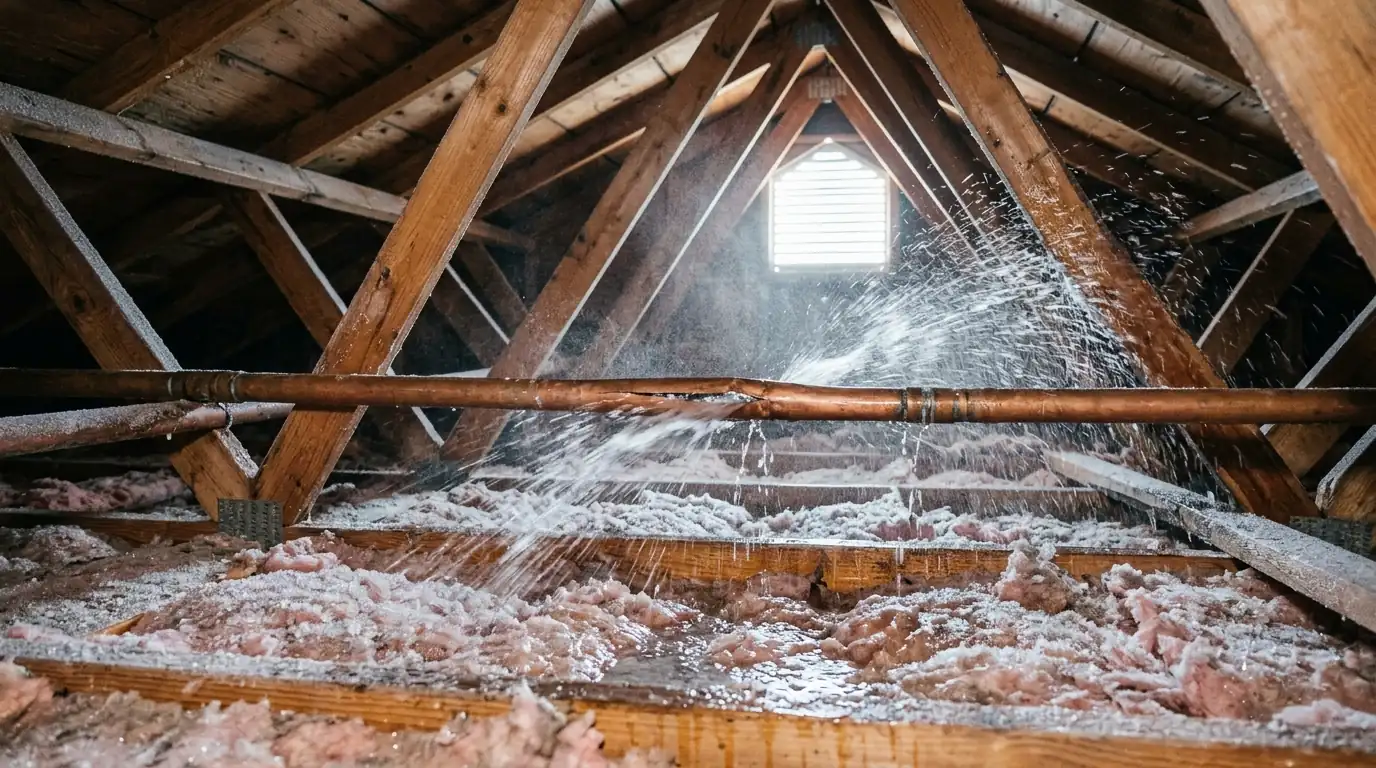
Water expands as it turns to ice, and the pressure it builds splits pipe or pushes fittings apart. The break often doesn't leak until the ice thaws, so the first sign may come hours after the cold snap ends. Pipes in exterior walls, in the attic over the garage and on outside hose bib runs are the usual victims. We open the line where it split, look along the run for bulges or more cracks, and replace every damaged length. Insulating that run afterward is the step that stops a repeat.
Attic supply line breaks
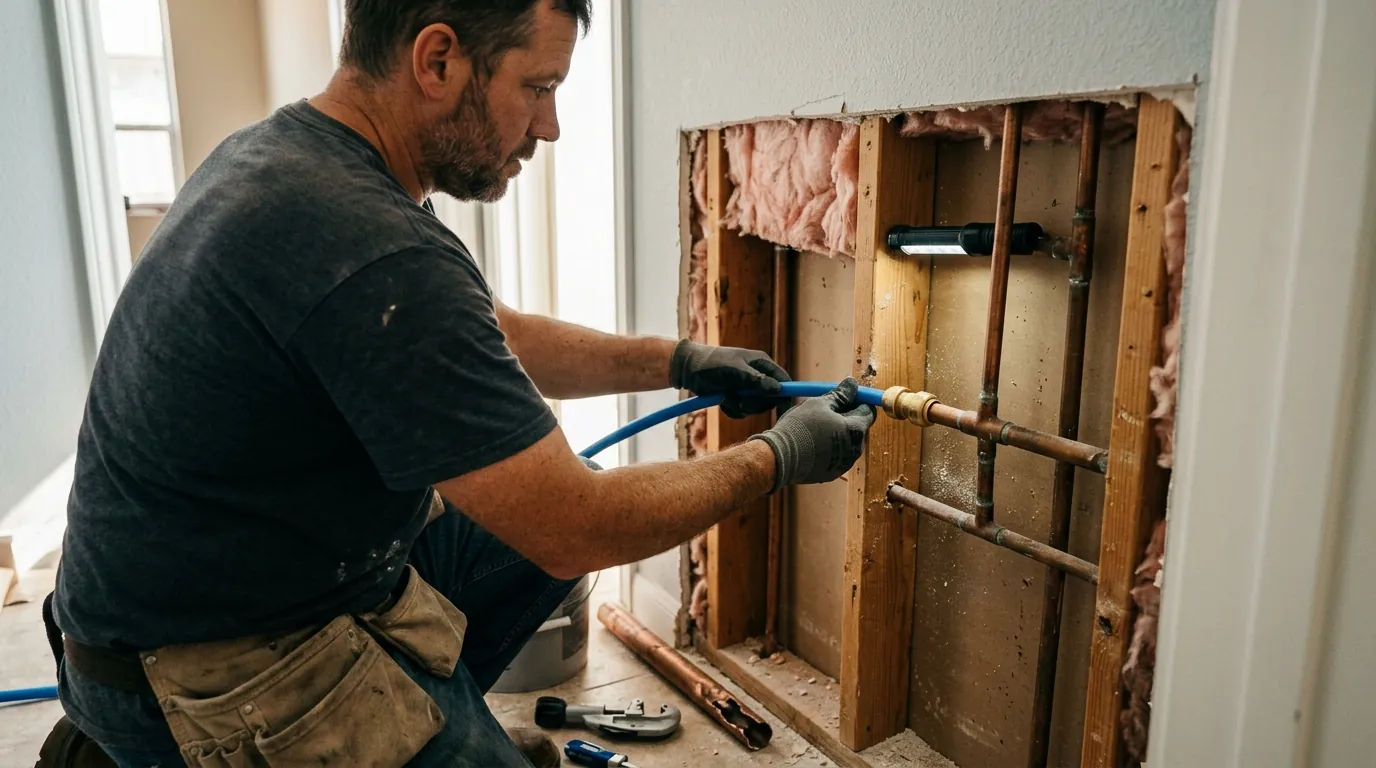
In many slab homes the supply lines run through the attic, so a break there shows as a ceiling that bulges, drips or comes down. Close the main first, then poke a small hole at the lowest point of a sagging ceiling with a bucket underneath to relieve the weight. From above, we find the break, repair it on the joists, and check nearby fittings and straps. Wet insulation loses its value and holds water against drywall, so plan to replace it.
Water still running? Call before it spreads.
Call (281) 845-9645Failed PEX or CPVC fittings
Plastic pipe rarely bursts in the middle of a run. It fails at joints: a crimp ring that wasn't fully seated, a fitting stressed by pipe pulled too tight, or CPVC that has gone brittle with age and heat and cracks at the hub. These often let go with no warning. We cut back to sound pipe, install new fittings with the right tool for that system, and check other joints from the same install, since the same habit tends to repeat throughout a house.
Pinhole leaks in copper
A pinhole looks minor: a fine spray, a green crust on the pipe or a damp spot that keeps returning. It means the wall of the copper has worn through from the inside, and that run is likely thin in other places too. We can cut out the section and solder or press in new pipe, which makes sense for a single leak. A second or third pinhole on the same line is the point to price a repipe against more patches.
Local conditions
Freezes are rare enough in Pearland that attic and exterior-wall pipes are often left bare. NWS Houston's February 2021 summary records a Hobby low of 17 degrees on Feb 15 and 15 degrees on Feb 16, and says the event brought broken pipes to the region. TCEQ required Pearland's public water system to issue a boil water notice on February 16, 2021, rescinded February 21, 2021. Many breaks from a week like that only show once pressure comes back, which is typical of freeze damage.
Sources: weather.gov, pearlandtx.govWhat decides the price of a burst pipe repair
A published Houston cost guide gives the planning ranges below, for the pipe repair and for water damage cleanup listed separately. The pipe repair itself depends on these factors.
Published planning ranges
- $395 to $1,480 in Houston, plus $990 to $1,970 for water damage cleanup, per Angi (May 13, 2026)
- Where the break is. An open attic or garage wall is quick to reach; a pipe above a finished ceiling or behind tile is not.
- Pipe material. Copper, PEX and CPVC each use different fittings and tools, and older material may need a longer cut-out.
- How many breaks. A freeze can split one pipe in several places, and every one has to be found and repaired.
- Access and patching. Opening drywall to reach the pipe is part of the repair; finishing that drywall is a separate trade.
What to handle yourself and what to leave to us
What you can do safely
- Close the main and open a low faucet
- Turn off the water heater supply and power
- Relieve a sagging ceiling at its lowest point
- Move belongings and photograph the damage
When to call a plumber
- Soldering or press-fitting copper near framing
- Crimping or expanding PEX with the right tool
- Finding hidden splits along a frozen run
- Pressure-testing before walls close
What a burst pipe repair includes
- Main or branch shutoff and line drain
- Inspection of the whole exposed run
- Removal of every damaged section
- New pipe and fittings matched to the material
- Pressure test before water is restored
- Photos of the failure for your records
Questions about burst pipe repair in Pearland
Not with the main wide open. Leave it closed until the break is found, because full pressure can turn a crack into a flood. If we need to find a second leak, we'll restore pressure slowly while watching.
Repair tape or a clamp can slow a pinhole on copper, but it won't hold a split under pressure. Closing the valve does more. Treat any wrap as temporary and have the section replaced.
Ice can hold a split closed until it melts, and some damage only opens up once full pressure returns. Check attic, garage and exterior-wall lines after any hard freeze, even if nothing leaked at first.
Usually just the damaged section. Repeated failures on the same run, brittle CPVC or copper with several pinholes are the exceptions, and we'll show you what we see before you decide.
Many policies cover sudden water damage but not the pipe itself or slow leaks; your agent can confirm. We photograph the failed section and the repair so you have records for an adjuster.