Updated October 2026
Quick answer
A Pearland restaurant's grease interceptor needs pumping before fats, oils and food solids fill a quarter of its depth; past that, grease starts slipping out toward the city sewer. How often that happens depends on the trap's size and your menu, so the schedule should come from measured readings, not the calendar alone.
What a grease trap service includes
- Grease and solids depth readings
- Full pump-out, including settled solids
- Baffle, tee and lid inspection
- Line jetting when the kitchen drains are slow
- Hauling to a permitted disposal facility
- A dated log entry for inspectors
A grease interceptor is a tank, inside under a sink or buried out back, where kitchen wastewater slows down long enough for grease to float and solids to sink. Baffles hold both back while clearer water leaves through the outlet. It works only while there's room left inside.
Most kitchen backups we see aren't the interceptor itself. They're grease hardening in the pipe between the sinks and the trap, where hot water cools and fat sticks to the walls. Good service covers the tank and the lines feeding it.
Local conditions
NWS 1991-2020 normals for Houston Hobby show an annual precipitation normal of 55.62 inches. That much rain matters to an outdoor interceptor in Pearland: a cracked lid or a loose riser lets stormwater in, which stirs settled solids, pushes grease out the outlet and fills the tank with water you then pay to haul. We check lids, risers and the ground around them at every pumping so heavy rain stays out of the trap.
Sources: weather.govInterceptor pumping
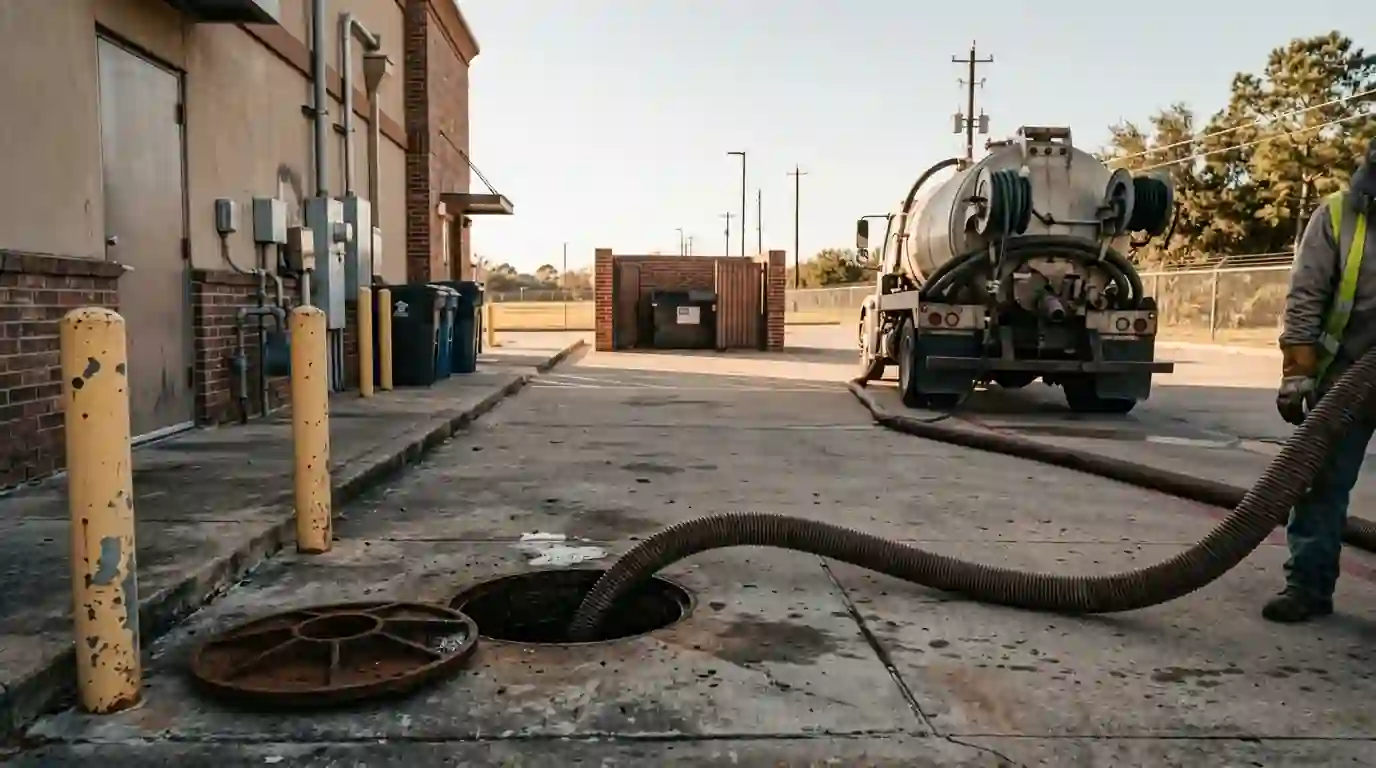
Pumping means removing everything: the floating grease cap, the water and the solids settled at the bottom. Skimming only the top leaves the solids to keep building, which shrinks capacity and causes odors. We measure grease and solids depth before pumping so you have a reading to set the next interval by. Small under-sink traps can be cleaned by hand during a slow hour. Large outdoor interceptors need a pump truck and a hauler that takes the waste to a permitted facility.
Line jetting from trap to tap
Grease that cools in the drain line between your sinks and the interceptor coats the pipe like candle wax, narrowing it until the dish machine or floor drains back up. Snaking punches a hole through it but leaves the walls coated, so the clog returns. Hydro jetting scours the pipe walls back to the original diameter and pushes the loosened grease into the trap, where it can be pumped. We time jetting just before pumping so nothing ends up downstream.
Baffle and lid repair
The baffles inside an interceptor force water under and around them so grease stays trapped. When a baffle rots, cracks or falls off, grease runs straight through to the outlet and the trap stops doing its job, even if it was just pumped. Concrete interceptors also suffer from the acids that grease breaks down into. We inspect baffles, inlet and outlet tees and lids at every pumping, and replace broken lids, since a cracked lid is a trip hazard and lets rainwater in.
Service logs for inspectors
Health and pretreatment inspectors ask for the same things: when the trap was last serviced, how full it was and who hauled the waste. A log with dates, depth readings and manifest numbers answers those questions in a minute. Each visit, we record what we pumped, the grease and solids readings and any repair, and give you a copy for the binder kept on site. Readings across several visits also show whether your interval is too long or too short.
How a grease trap service call goes
- Measure firstWe read grease and solids depth so the log shows how full the trap was.
- Pump it outWe remove the grease cap, water and settled solids, not just the top layer.
- Inspect and jetWe check baffles, tees and lids, then jet the kitchen lines when needed.
- Log the visitYou get a dated record with readings, repairs and the hauling details.
Signs your grease trap is overdue
- Sinks and floor drains slow to empty
- A rancid smell near the trap or the back door
- Grease showing at the outlet or the cleanout
- Water pooling around an outdoor lid after rain
- Gurgling from floor drains when the dish machine drains
What drives the cost of grease trap service
Sample Texas bids for trap cleaning, gathered by a grease trap pricing site, appear below. Your price moves with these factors.
Published planning ranges
- $190.00, $250.00 and $550.00 per service in three Texas bids for a 1,000-gallon trap, per Grease Trap Locator (September 23, 2026)
- Trap size. A small under-sink trap is a quick hand job; a large interceptor needs a pump truck.
- Time since last service. A trap left too long holds hardened grease and more waste to haul.
- Line jetting. Clearing the lines from the kitchen to the trap adds time and equipment.
- Repairs. Broken baffles, cracked lids or failed tees add parts and labor.
Questions about grease trap service in Pearland
Often enough that grease and solids never fill a quarter of the trap's depth. For a busy fryer kitchen with a small trap, that can be monthly; a coffee shop may go much longer. Depth readings across a few visits set the right interval.
Enzyme and bacteria products can help with odor, but many simply break grease into smaller pieces that reform further down the line. They don't remove solids. Treat them as an extra, not a substitute for pumping.
Usually because the clog is in the line between the sinks and the trap, not the trap itself. Hardened grease on pipe walls needs jetting. Our hydro jetting page explains how that works.
As little grease and food as possible. Scrape plates into the trash, wipe pans before washing and collect fryer oil separately for recycling. Use strainers on sinks and floor drains to catch solids before they reach the trap.
Yes. Pumping can be noisy and smelly, so most kitchens prefer early mornings or after close. Backups that hit in the middle of service get an answer 24/7.