Updated October 2026
Quick answer
Going tankless in Pearland usually means more than swapping boxes on the wall. A whole-house gas unit can draw several times the gas of a standard tank, so the line often needs upsizing, and the venting changes too. Unit size follows your peak hot water flow, and the gas and vent work is planned around it.
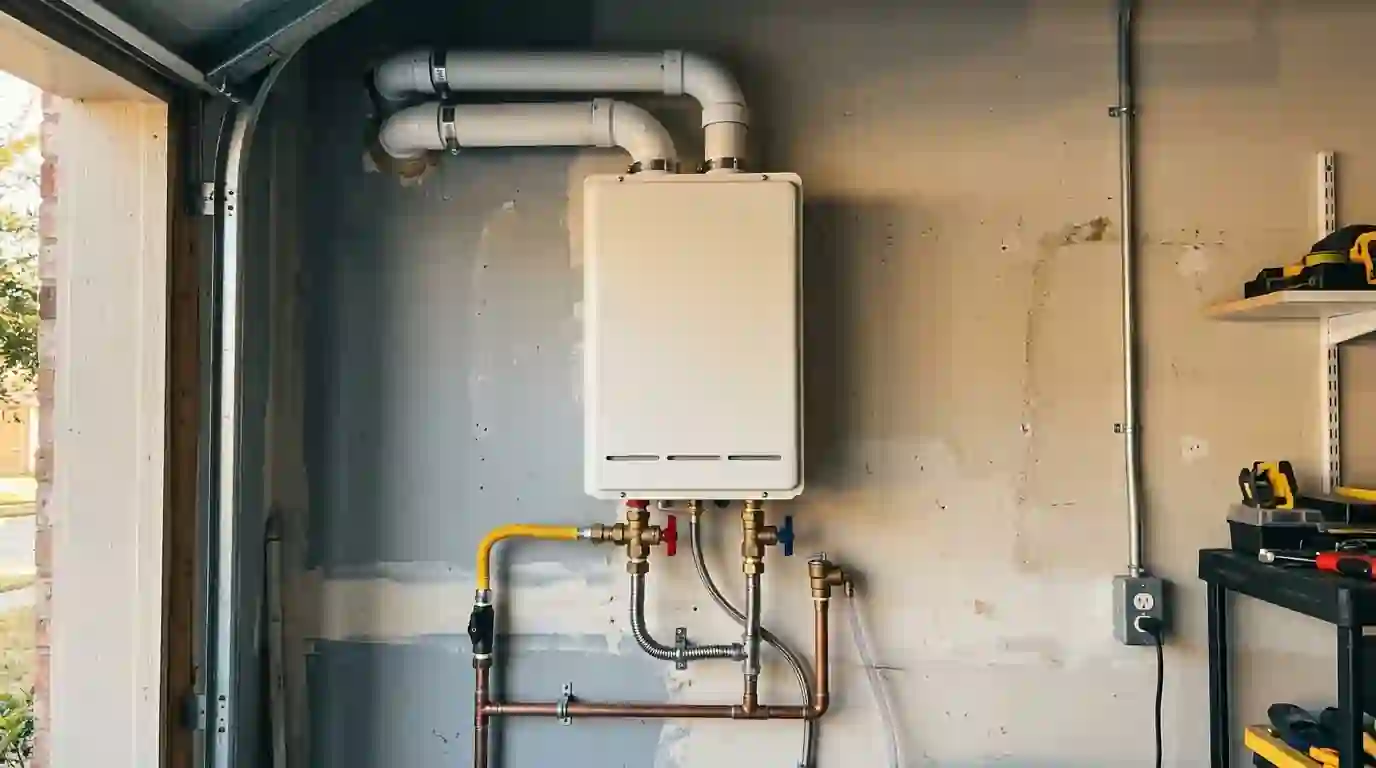
A tankless heater fires only when a tap opens, heating water as it passes through a heat exchanger. It gives continuous hot water up to its rated flow, measured in gallons per minute. Open more taps than it can carry and the temperature drops, so sizing starts with how many fixtures run at once.
The honest tradeoff: a tankless install costs more up front than a tank, and it needs yearly descaling to stay healthy. In return you get a smaller footprint and no standing tank to rust out. Our tank vs tankless guide walks through the choice.
Tank or tankless: how they stack up
| Question | Gas tank | Gas tankless |
|---|---|---|
| Hot water supply | Stored, can run out | Continuous up to rated flow |
| Space | Floor space for the tank | Wall-mounted unit |
| Gas line | Usually the existing line | Often a larger line |
| Upkeep | Periodic flush | Yearly descaling |
| In a power outage | Many standing pilot models work | Stops |
Why tankless installs vary so much in price
A Houston planning range is shown below. Most of the spread comes from the gas and vent work, not the unit.
Published planning ranges
- $1,977 to $4,462 in Houston (typical $3,206), per Angi (Feb 25, 2026)
- Gas line size. If the existing line cannot carry the unit, a new run from the meter adds material and labor.
- Venting route. A short vent through an outside wall is simpler than a long run through the attic and roof.
- Unit type and capacity. Condensing units and higher-flow models cost more than smaller non-condensing ones.
- Electrical and drain needs. An outlet near the unit and a condensate drain may need adding.
What a tankless install covers
- Load and flow sizing before the unit is chosen
- Removal of the old tank
- Gas line sized to the unit and pressure tested
- Vent run to code through wall or roof
- Isolation valves for yearly flushing
- Permit, inspection and a walkthrough of the controls
Tank to tankless conversion
Most conversions mount the new unit on a wall near the old tank, either in the garage or on an outside wall. The old tank comes out, the hot and cold lines are rerouted to the new unit, and service valves are added so it can be flushed. Some homes do better with the unit moved to an exterior wall, which shortens the vent. Expect wall patching where pipes and vents change. Gas units also need a 120-volt outlet nearby for the controls and fan.
Gas line and venting upgrades
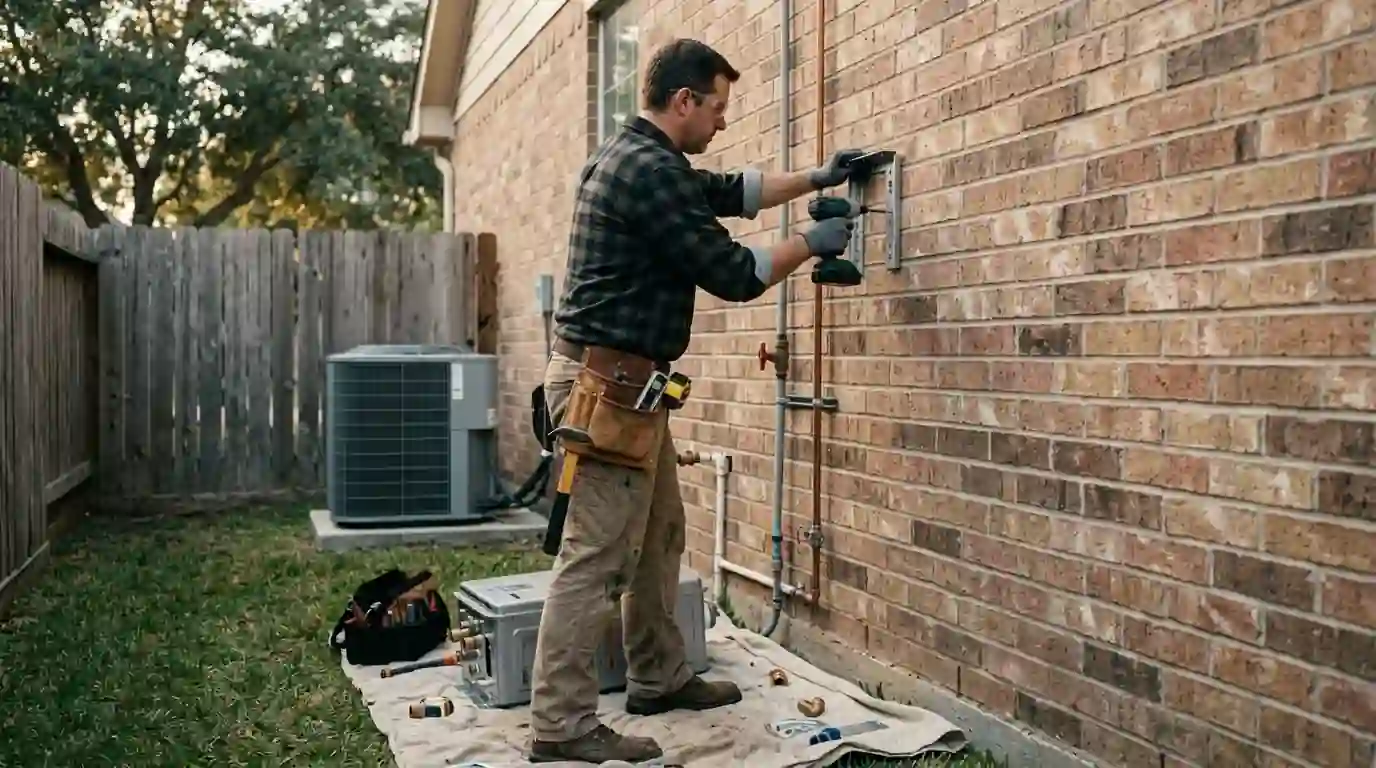
A whole-house tankless unit can need a gas line larger than the one feeding your old tank, from the meter to the heater. We add up every gas appliance on the system and measure the run before sizing anything. Venting changes too: tankless units use sealed vents through a wall or roof, and the old metal flue cannot be reused for most of them. Count on a new vent opening, a new or larger gas run, and sometimes a meter upgrade from the gas utility.
Condensing vs non-condensing units
A condensing unit uses a second heat exchanger to pull more heat from the exhaust. The exhaust runs cool enough for PVC vent pipe, but the unit produces acidic condensate that needs a drain and usually a neutralizer. A non-condensing unit has hotter exhaust that needs stainless steel venting, and no condensate drain. Condensing models typically cost more but squeeze more heat from each unit of gas. Where the heater sits and how the vent can run often decides between them.
Recirculation-ready installs
Tankless heaters fix running out of hot water, not waiting for it. If the far bathroom takes a long time to get hot today, it still will after the switch. Many units now include a built-in recirculation pump or accept one, and some work with a crossover valve under the farthest sink. If you want that, choose a compatible model and plan the plumbing at install time, when it is easiest to add. Our recirculation page covers the options.
Local conditions
Gas sizing and venting on a tankless install both fall under code, since Pearland's adopted codes include the 2021 International Fuel Gas Code, with local amendments. Water matters as well. Houston's 2025 Water Quality Report says the main system is 90.3% surface water, with total hardness averaging 135.5 ppm (range 43.5-229). Minerals at that level scale a heat exchanger over time, so every unit we install in Pearland gets isolation valves for the yearly flush.
Sources: pearlandtx.gov, houstonpublicworks.orgHow a tankless conversion comes together
- Size the demandWe count fixtures that run together and check the gas load and meter before choosing a unit.
- Plan gas and ventYou see the new gas route, the vent location and any outlet or drain the unit needs.
- Install and connectThe old tank comes out, the unit is mounted, piped, vented and fitted with service valves.
- Test and teachWe fire the unit, check gas pressure and flow, then show you the flush valves and settings.
Questions about tankless water heater installation in Pearland
It gives continuous hot water up to its rated flow. If more fixtures run at once than it can heat for, the water cools. Sizing it to your peak use is what keeps showers steady.
Often, if the gas line, venting and outlet can be brought there. Sometimes an outside wall is the better spot because the vent run is shorter. We look at both before quoting.
Yes. The heat exchanger should be descaled about once a year with a pump and vinegar or a descaling solution, and the inlet filter cleaned. Skipping it lets scale build up and leads to error codes.
Whole-house electric units need very large circuits, often more than a typical panel can spare. They work better for a single sink or a small home. We check your panel before recommending one.
No. Gas tankless units need electricity for the controls, igniter and fan, so they stop when the power does. A standing pilot gas tank may keep working, which some households weigh in the decision.