Updated October 2026
Quick answer
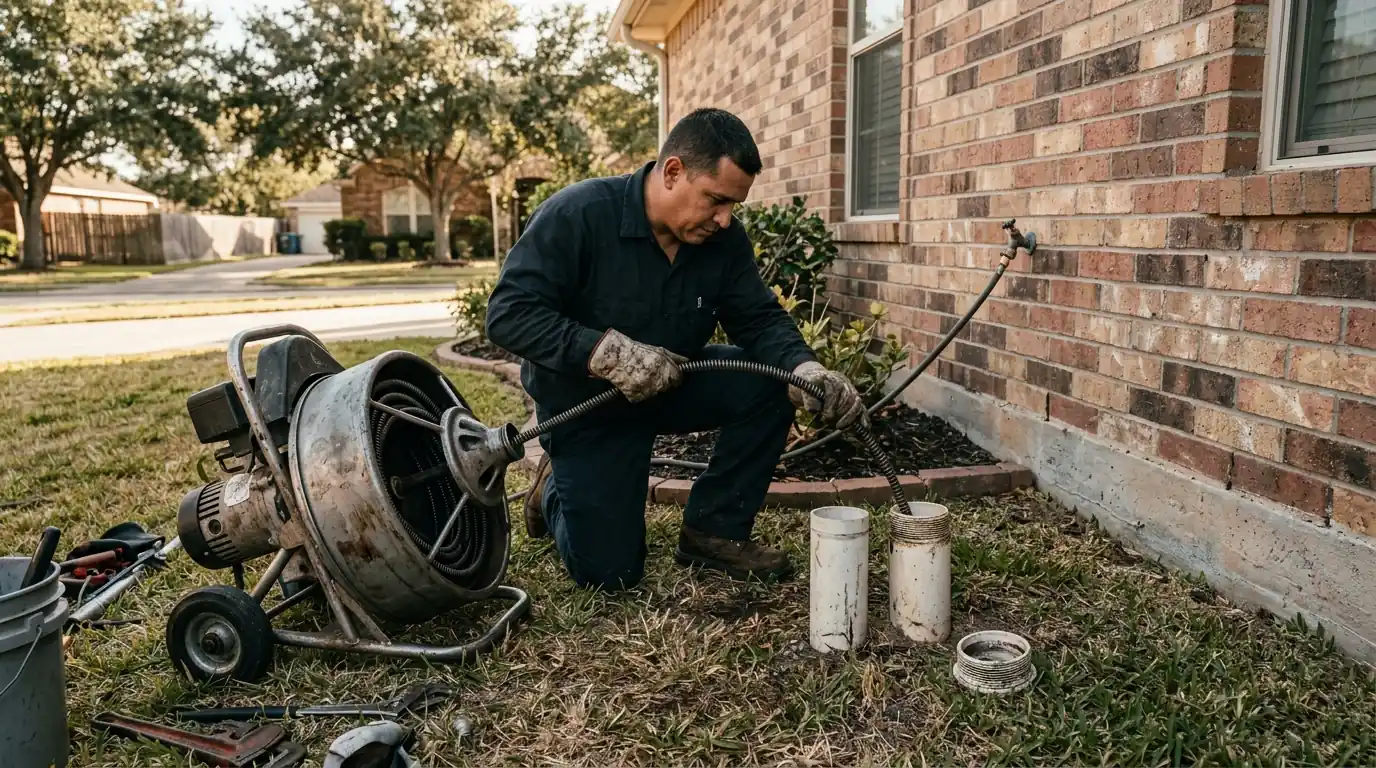
A Pearland sewer cleanout is a capped riser that opens into the main drain line outside the house, giving a cable or camera direct access without pulling a toilet. Adding one means exposing the line near the foundation, cutting in a wye or two-way fitting and bringing a riser up to finished grade with a sturdy cap.
A good cleanout pays for itself on the first clog. It keeps machines and sewage outdoors, lets a camera go straight down the main, and gives you somewhere to relieve pressure before a backup reaches the tub.
Location matters as much as the fitting. Near the foundation, where the drain leaves the house, covers the whole yard line. A cleanout that ends up under a deck, a driveway or a planted bed defeats the purpose, so we set it where you can reach it.
Single or two-way cleanout: which fits your line
| Question | Single cleanout | Two-way cleanout |
|---|---|---|
| Direction of access | Toward the street only | Toward the street and the house |
| Clogs it can reach | Yard line downstream | Yard line and drains under the slab |
| Typical location | Anywhere along the yard line | Near the foundation |
| Best fit | Adding access on a long run | Main access point for the whole house |
What goes into the price of a cleanout
Cleanout jobs run from replacing a cap to cutting into a buried line, so no single published range fits. These are the factors that set your price.
- New cleanout or raising one. Extending an intact riser is a short job; cutting a fitting into the line takes more digging.
- Depth of the line. A shallow line near the foundation is quicker to expose than a deeper one.
- Pipe material. Splicing into old clay or cast iron takes more care than tying into existing PVC.
- Surface at the spot. Grass is quick to put back; concrete, pavers or planted beds add work.
What a cleanout installation includes
- Locating the line near the foundation
- Excavation to expose the pipe
- Wye or two-way fitting spliced into the main
- Riser brought to finished grade
- New cap and cover box where needed
- Flow test and surface restoration
Two-way cleanouts
A single cleanout usually points toward the street, so a cable can only go one direction. A two-way cleanout has two openings, one aimed at the house and one at the city connection, so a clog on either side can be reached from the same spot. That matters when the blockage turns out to be under the slab rather than in the yard. When we add a cleanout to a line that serves the whole house, a two-way fitting near the foundation is usually the better choice.
Adding a cleanout to an old line
Many older homes were built with only an indoor cleanout, or with one in a spot that has since been paved over. Adding one starts with locating the line where it leaves the house, then digging a pit to expose it. We cut out a short section of pipe, splice in the fitting with shielded couplings, and run the riser to grade. On clay or cast iron, the transition to PVC is the part to get right, since that joint carries the whole house.
Raising buried cleanouts
Cleanouts disappear under new landscaping, sod and mulch more often than they fail. A buried cap gets missed during an emergency and sometimes cracked by a shovel or mower. If the riser is intact, we dig it out, extend it to finished grade with a new section and cap, and set it in a small box or collar if it sits in a bed. If the riser is broken below ground, that piece gets replaced so roots and rainwater can't get in through it.
Cleanout caps and covers
A missing or cracked cap lets rainwater, soil and small animals into the sewer line, and lets sewer gas out into the yard. Caps are inexpensive, but the threads on old fittings can be worn or corroded. We replace the cap with one that fits the riser, or replace the top fitting if the threads won't hold. In lawns we often add a cover box so the cap stays visible and a mower or vehicle can't hit it.
Local conditions
Newer homes here are inspected before anything is buried: Pearland's new residential permit process requires a plumbing ground inspection before the foundation is poured, a plumbing rough-in at framing, and a gas test. The code calls for cleanouts on building drains, so a recent home usually has one. Age changes the picture. HAR counts 1,666 single-family properties in Southwyck with a median build year of 1994, and after three decades of landscaping, a cleanout on a home that age may be buried, cracked or covered.
Sources: pearlandtx.gov, har.comHow a new cleanout goes in
- Find the lineWe locate where the drain leaves the house and pick a spot you can always reach.
- Expose and cut inA pit exposes the pipe, and a wye or two-way fitting is spliced in with shielded couplings.
- Bring it to gradeThe riser comes up to finished grade with a tight cap and a cover box where needed.
- Test and backfillWe run water through the line, check the joints and restore the surface.
Questions about sewer cleanout installation in Pearland
Look near the foundation where the plumbing leaves the house, usually on the side closest to the street, for a capped white or black pipe a few inches across. Check under mulch, shrubs and decking. If you can't find one, we can locate the line.
Current code calls for a cleanout where the house drain meets the sewer, so newer homes usually have one. An older house without an accessible outdoor cleanout still works, but every main line clog means going through a toilet or roof vent.
Yes, and it's the best time. If we're already digging to repair or replace the yard line, adding a cleanout costs much less than doing it as a separate job later.
Opening it can relieve pressure and show whether the clog is toward the street, but sewage may come out. Unscrew the cap slowly, stand to the side and wear gloves. If you're unsure, leave it closed and call us.
Replace it soon. A cracked cap lets rainwater and soil into the sewer and lets sewer gas out. If the threads on the fitting are worn, the top fitting may need replacing too.