Updated October 2026
Quick answer
In a Pearland walk-in tub, hot water is the plumbing question that matters most: you sit inside while it fills and while it drains, and many models hold more than a standard tub. We check that your water heater can fill it at a comfortable temperature before you choose a model.
Accessible plumbing covers more than the tub. It includes a shower you can roll or walk into without a step, a toilet at chair height, faucets you can work with a closed hand and a shower valve that holds temperature when someone flushes.
Most of these changes fit inside the existing bathroom. The bigger jobs sit under the floor, where a slab may need cutting to lower a drain, so we price the whole plan and let you decide what to do now and what can wait.
Walk-in tub or curbless shower
| Question | Walk-in tub | Curbless shower |
|---|---|---|
| Getting in | A low step through a sealed door | No step at all |
| Wheelchair access | Needs a transfer to the seat | Roll-in with a shower chair |
| Hot water demand | High, since it fills fully | Same as any shower |
| Floor work | Usually none | Concrete cut to lower the drain |
What sets the price of an accessible bathroom
We don't publish a planning range for this work because the scope varies so widely. Four factors move a quote the most.
- The fixture you pick. Soaking-only walk-in tubs cost less than models with jets, heated seats or quick-drain systems.
- Hot water supply. A larger tub can mean a bigger water heater or a booster, which adds to the job.
- Concrete work. A curbless shower on a slab means cutting and repouring concrete to lower the drain.
- Walls and finishes. Tile, backer board and blocking for grab bars add work beyond the plumbing itself.
What an accessible fixture install includes
- Removing the old tub, toilet or shower valve
- Resetting drain and supply lines to the new fixture
- A pressure-balancing or thermostatic valve
- A temperature limit on the tub filler
- Fill, drain and leak testing
- Hauling away the old fixture
Walk-in tubs
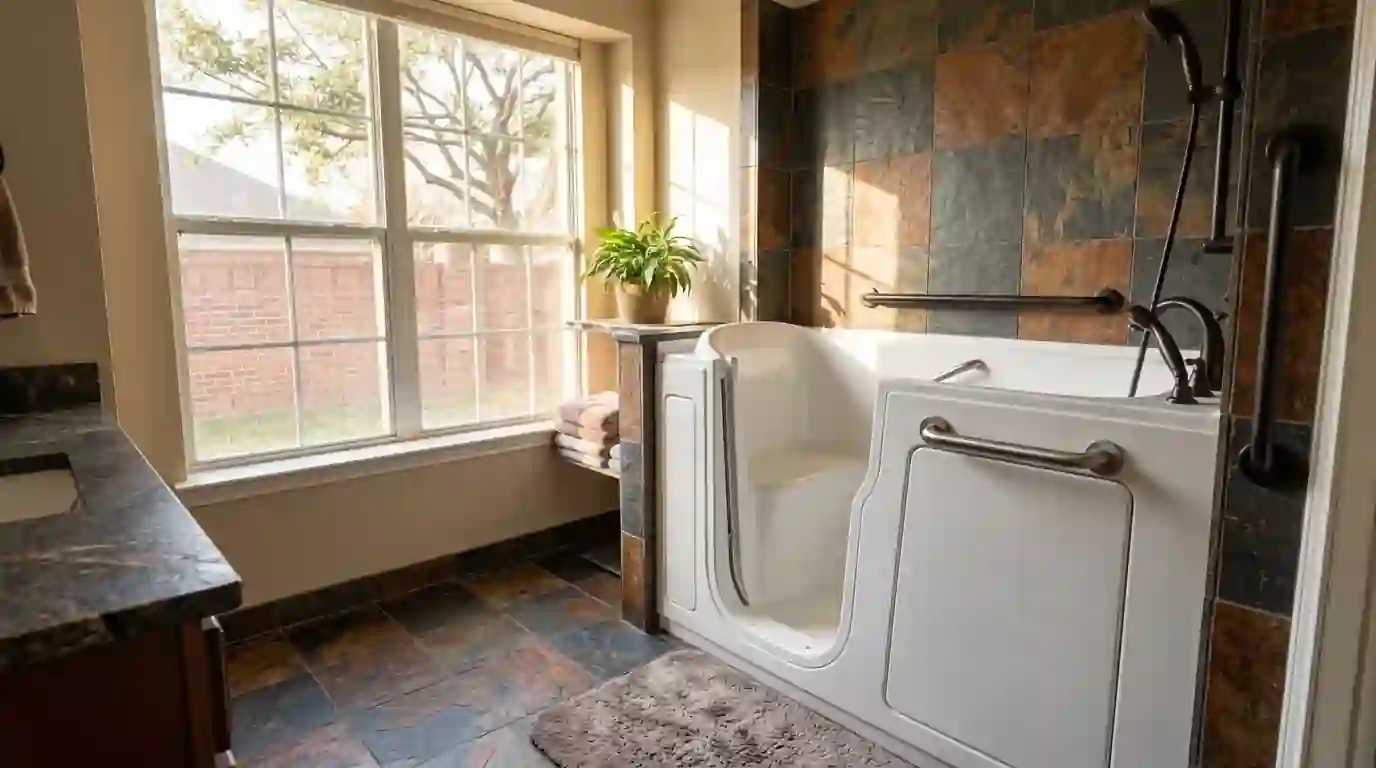
A walk-in tub has a sealed door and a raised seat, so you step over a low threshold and sit down before it fills. Two things decide whether it works day to day. The water heater must fill it hot enough without running cold halfway, which a standard 40 or 50 gallon tank may not do for larger models. The drain must empty it quickly, since you wait inside until the door can open. We check both, and models with jets or a heater need a dedicated electrical circuit from an electrician.
Curbless shower plumbing
A curbless shower lets a walker or wheelchair roll straight in, which means the shower floor has to sit level with the bathroom floor and still slope to a drain. On a slab, that means cutting concrete to drop the drain and trap, then sloping a new mortar bed under a waterproof membrane. A linear drain along the back wall keeps the slope in one direction and is easier to cross. Expect the bathroom to be out of use while the concrete and membrane cure.
Comfort-height toilets and lever faucets
A comfort-height toilet puts the seat closer to chair height, which makes sitting and standing easier on knees and hips. The swap uses the same drain, though we check the flange height and the floor under it, since a soft subfloor or a cracked flange shows up once the old bowl comes off. Lever and single-handle faucets replace knobs that need a firm grip and a twist. Choose levers long enough to push with the back of a hand.
Hand-held showers and thermostatic valves
A hand-held shower on a slide bar lets someone wash seated, with the head set at whatever height suits them. The valve behind it matters more. A pressure-balancing valve stops sudden scalds when a toilet flushes, while a thermostatic valve holds the temperature you set and allows a stop that limits how hot the water can get. Older bathrooms often still have the original valve, so this is the time to update it, since the wall is already open.
Local conditions
Country Place is a gated 55+ community of 841 homes built between 1981 and 2000, and HAR puts the median build year of its 674 single-family properties at 1992. That means many bathrooms there still carry original tub and shower layouts and valves that may predate today's anti-scald rules. When Country Place owners ask about a walk-in tub, we check the shower valve, the water heater size and the drain under the tub together, because an accessible bathroom in a home of that age often needs all three updated.
Sources: houstonproperties.com, har.comHow an accessible bathroom install runs
- Measure and checkWe measure the space and check the water heater, drain size and valve already in place.
- Choose the layoutYou choose fixtures knowing the hot water and concrete each option would need.
- Rough-inWe remove the old fixture, reset the drain and supply lines, and install the new valve.
- Fill and testWe fill and drain the tub or run the shower, checking temperature, flow and every seal.
Questions about walk-in tub & accessible fixtures in Pearland
Often, yes. Many models are built for a standard 60-inch alcove, so the drain and supply stay close to where they are. Doorways and hallways matter too, since the tub has to fit through them in one piece.
Only if the tank holds enough for the tub's volume. A standard 40 gallon tank may run short on a larger model. We compare the two before you order, and a bigger tank or tankless unit may be the answer.
For someone who uses a walker or wheelchair, usually yes, since there is no threshold and no waiting while it drains. A walk-in tub suits people who want to soak and can manage a low step.
Original Medicare generally does not treat a walk-in tub as medical equipment. Some private plans and local programs help with home safety changes, so check your own plan before you buy. We can document the work for your records.
Yes. We open the wall, move the valve and add a hand-held shower on a slide bar. While the wall is open, it's a good time to add blocking for grab bars.