Updated October 2026
Quick answer
A humming Pearland garbage disposal is usually jammed: something is wedged between the turntable and the grind ring, and the motor cannot spin. Freeing it with the hex key at the bottom and pressing the reset button fixes many. A unit leaking from its body, rather than a fitting, has a failed internal seal and needs replacing.
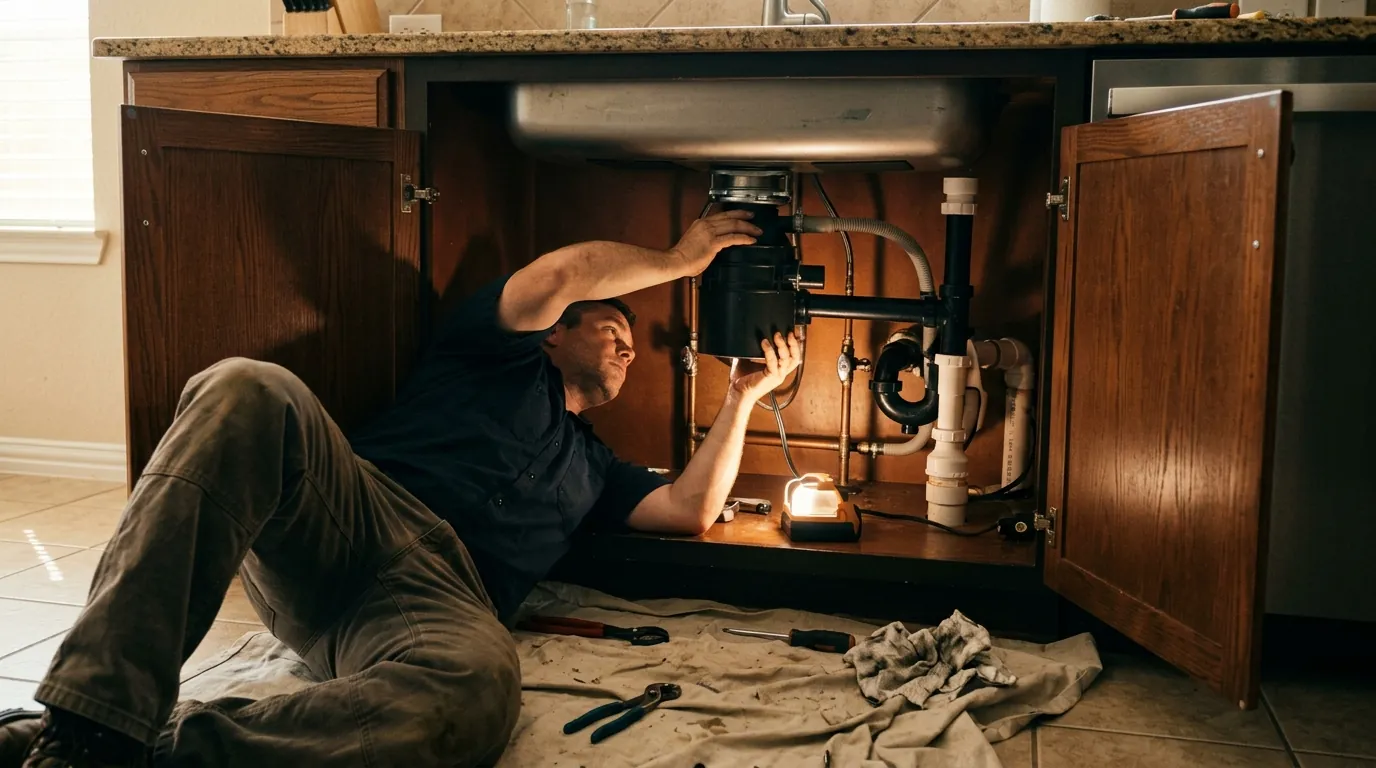
A disposal hangs from a mounting ring under the sink. Food drops onto a spinning plate, gets thrown against a grind ring and washes into the drain. Most calls come down to a jam, a tripped overload, a loose fitting or a body that has worn through.
Not every problem is the disposal itself. A slow sink with a working disposal often means the drain line beyond it is clogged. A dishwasher that will not drain can point to a blocked disposal inlet. We test the sink, disposal and dishwasher drain together so the right part gets fixed.
Disposal pricing: swap, upgrade or first install
Published planning ranges for a straight swap and for a first-time retrofit appear below. Four things move your price within them.
Published planning ranges
- $200 to $550 to replace a unit on existing connections; $250 to $650 for a new retrofit, per HomeGuide (April 5, 2023)
- Swap or new install. A unit on existing connections is quicker than a first install that needs power and drain changes.
- Motor size and model. Larger motors and quieter insulated units cost more than a basic builder-grade disposal.
- Electrical at the sink. Adding a switch or outlet where none exists adds work beyond the plumbing.
- Drain and dishwasher fittings. Old trap pieces, a missing air gap or a misaligned drain line add parts and time.
Jammed or humming disposal
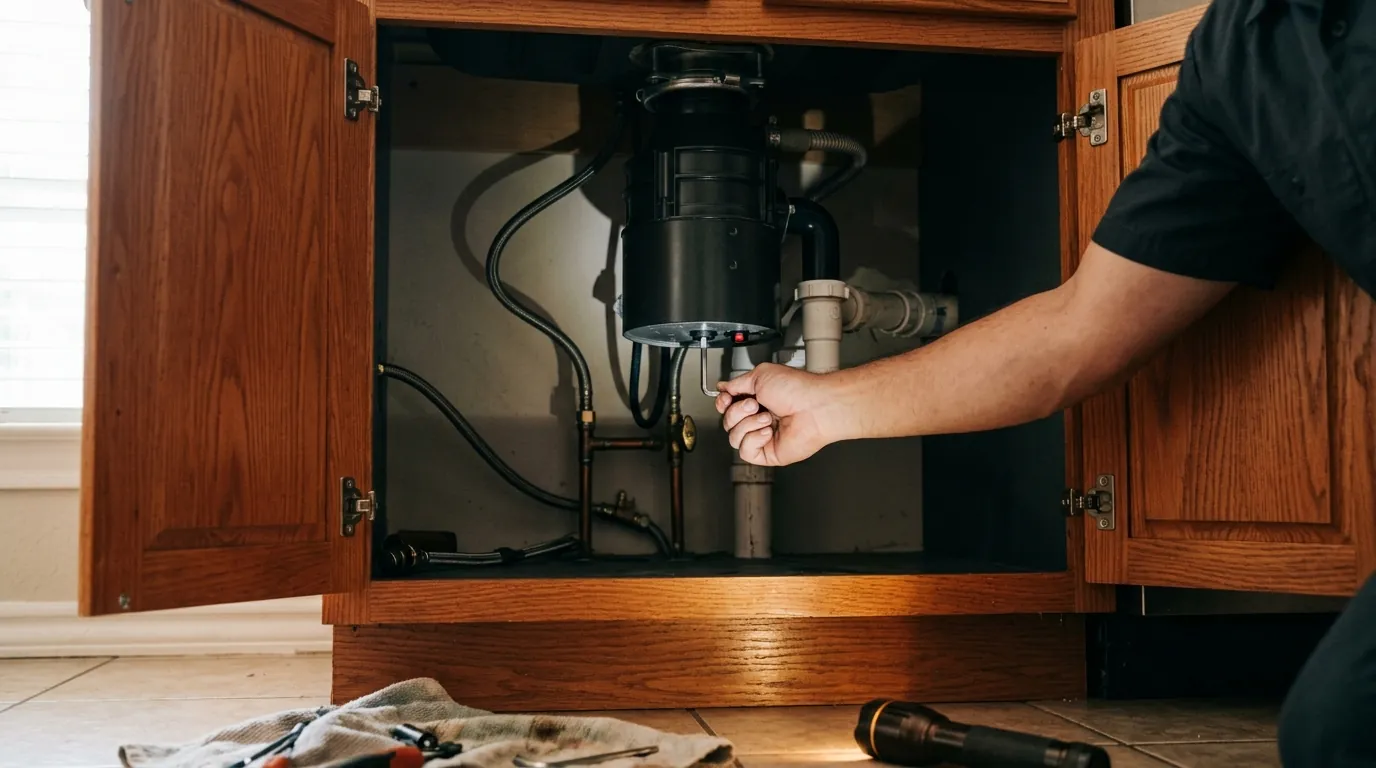
A hum with no grinding means the motor has power but the plate is stuck, often on a fruit pit, bone, bottle cap or silverware. Turn off the switch, then work the hex key back and forth in the socket on the bottom until it turns freely, and press the red reset button. If it trips again right away or hums after clearing, the motor or bearings may be failing. Never reach in by hand, even with the power off; use tongs.
Leaking disposal
Where the water comes from decides the fix. A leak at the top usually means the sink flange has lost its seal and needs new putty. A leak at the side points to a loose dishwasher hose or drain elbow gasket. Water dripping from the bottom of the unit means the internal seals have failed, and that cannot be repaired. We dry everything, run water and watch each joint, then reseal, tighten or replace the unit. Check the cabinet floor for swelling.
Replacement units
Replacing a worn-out disposal is usually a direct swap on the same mount and drain, especially when the new unit uses the same mounting system. If the brand changes, we replace the sink flange and ring too. Horsepower matters: a stronger motor grinds harder food with fewer jams, but it is larger, so we measure the cabinet space. We also check whether the unit is hardwired or plugs into an outlet, and keep the electrical connection matched to what is under your sink.
New installs with dishwasher tie-in
Adding a disposal where none existed means mounting it in the sink opening, setting the drain height so it reaches the trap, and providing power through a switched outlet or hardwire. If a dishwasher drains through the disposal, the knockout plug inside the inlet must be removed, or the dishwasher will not drain at all. The dishwasher hose also needs a high loop or an air gap so dirty sink water cannot siphon back. If no switch exists near the sink, one has to be added.
Local conditions
HAR counts 6,180 single-family properties in Shadow Creek Ranch across its Brazoria (median built 2005) and Fort Bend (median built 2013) sections. A kitchen of that age may still run the builder's original disposal, often a smaller motor that jams more easily and wears sooner than a heavier unit. When it quits, a stronger model is worth a look rather than a like-for-like swap. The same holds across newer parts of Pearland, where original appliances tend to reach the end of their run around the same time.
Sources: har.comHow we sort out a disposal problem
- Test power and motionSwitch, outlet and reset button come first, then a hex key shows whether the plate turns.
- Find leaks or clogsWith water running through the sink and dishwasher drain, we watch every joint and the trap.
- Repair or replaceWe clear the jam, reseal the flange or fittings, or swap in a new unit you approve.
- Grind and drain testA grind test and a dishwasher drain cycle confirm it grinds, drains and stays dry.
Signs your disposal is failing
- Humming with no grinding when switched on
- Reset button tripping again and again
- Water dripping from the bottom of the unit
- Grinding noise or rattling that will not clear
- A smell that returns soon after cleaning
Disposal fixes for you and for a plumber
What you can do safely
- Clear a jam with the hex key under the unit
- Press the red reset button after it cools
- Clean the splash guard and run ice through it
- Check that the outlet and switch have power
When to call a plumber
- Leaks from the body or the sink flange
- Swapping a unit and its mounting ring
- Dishwasher drain changes and air gaps
- Clogs in the drain line past the trap
Questions about garbage disposal repair & installation in Pearland
Grease, fats, coffee grounds, eggshells, fibrous peels like celery or corn husks, pasta and rice in volume, bones and fruit pits. Starchy and fibrous foods pack into the drain line even when the disposal grinds them.
Food film builds up under the splash guard and on the grind chamber walls. Run cold water with a handful of ice and some citrus peel, then scrub the underside of the splash guard.
Cold. It keeps any grease solid so it gets chopped and flushed instead of coating the drain. Keep the water running a few seconds after the grinding stops.
The knockout plug in the dishwasher inlet was probably not removed. Disconnect the hose, knock the plug out and fish the piece out of the chamber. If it still will not drain, the hose may be kinked.
A jam or a loose fitting, yes. A unit leaking from its body or with a burned-out motor is usually not worth repairing. If the dishwasher line also needs work, see our appliance hookup page.