Updated October 2026
Quick answer
In Pearland, most leaking outdoor faucets come down to one of three parts: a worn washer or packing at the stem, a vacuum breaker whose seal has failed, or a frost-free barrel that split when a hose stayed attached through a freeze. The first two are repairs. A split barrel means a new sillcock.
An outdoor faucet looks simple, but the leak you can see is not always the one that matters. A drip from the spout is a seat washer. Water around the handle is packing. Water showing up inside, in the garage or behind a cabinet, means the pipe behind the faucet has cracked.
On slab houses, the line to a hose bib either rises from the slab inside the wall or drops from the attic. We trace which feeds yours and tell you whether a repair kit will hold or the valve should change.
Standard hose bib or frost-free sillcock
| Question | Standard hose bib | Frost-free sillcock |
|---|---|---|
| Where it seals | At the outside face of the wall | Inside the heated wall |
| Freeze risk | Water sits right at the cold surface | Low, if the barrel drains |
| Common failure | Washer, packing or a cracked body | Split barrel from an attached hose |
| Best fit | Covered spots used often | Most exterior walls |
Why one spigot repair costs more than another
A national cost guide's range for replacing an outdoor faucet appears below. Where your job lands depends mostly on what sits behind the wall.
Published planning ranges
- $150 to $450 on average, per HomeGuide (June 29, 2024)
- Repair kit or new valve. A washer and packing job costs less than cutting out and replacing the whole faucet.
- Wall finish. Brick needs a clean opening around the flange, while siding or stucco brings its own patch work.
- Damage behind the faucet. A crack back inside the wall means opening drywall or garage board to reach sound pipe.
- Hydrant depth. A yard hydrant needs a trench down to the buried valve, and wet clay digs slowly.
Leaking hose bibs
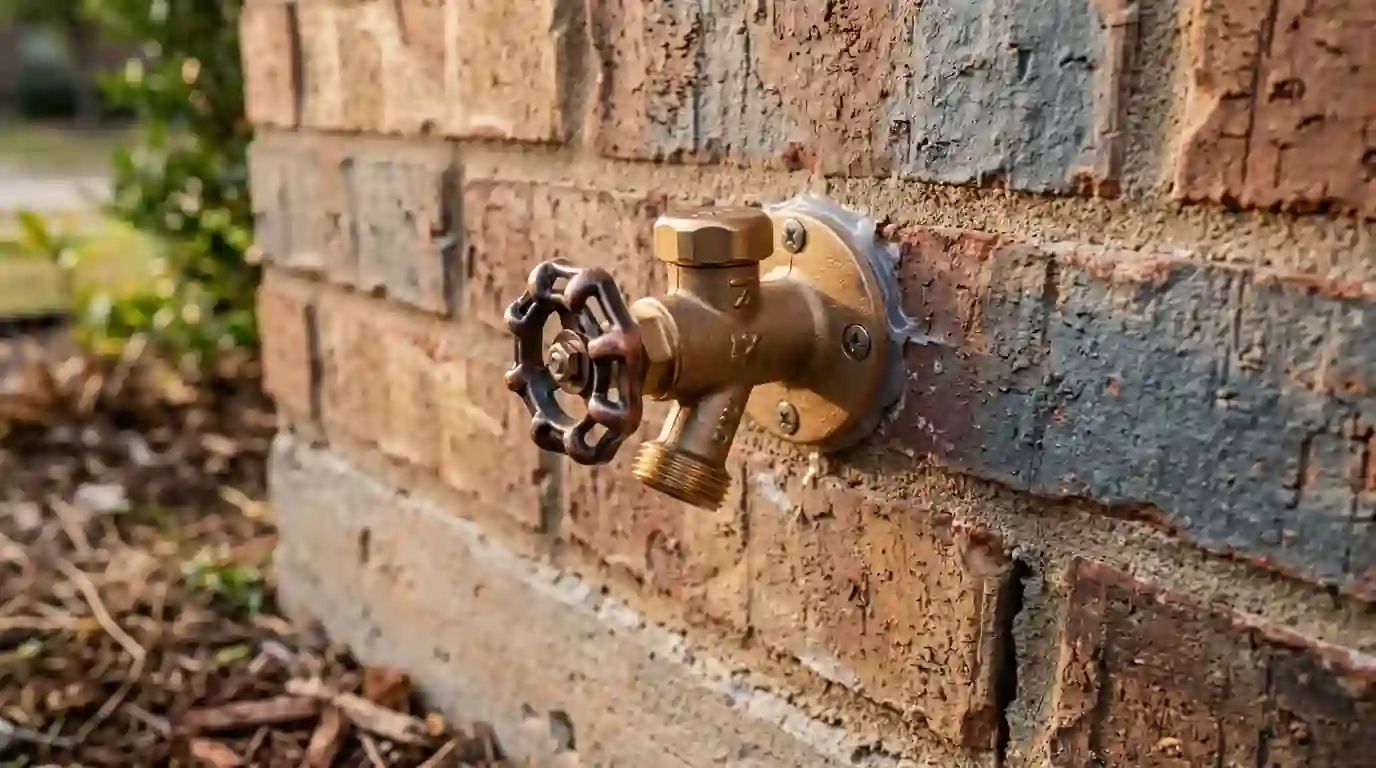
A compression hose bib leaks in two places. A steady drip from the spout with the handle closed means the seat washer has hardened or split, and the brass seat under it may be pitted. Water weeping around the stem while the faucet runs points to the packing. We replace washer and packing, dress the seat where the valve allows it, and make sure the faucet is fastened tight so cranking the handle doesn't twist the pipe behind it.
Frost-free sillcocks
A frost-free sillcock puts the real shutoff at the end of a long stem, inside the heated wall, so the barrel drains each time you close it. That only works if the barrel slopes outward and no hose is left on. An attached hose holds water in the barrel, it freezes, and the split stays hidden until spring, when water runs into the wall. A replacement has to match your wall thickness, and we seal the flange.
Vacuum breakers
The cap on the spout is a hose connection vacuum breaker. It keeps dirty water in a hose, a fertilizer sprayer or a pool from being siphoned back into your drinking water when pressure drops. A short spurt from the cap at shutoff is normal; a steady spray while the hose runs means the seal has failed. Many are made to be permanent, with a set screw that snaps off, so a failed one often means a new faucet.
Yard hydrants
A yard hydrant carries water to a garden, shop or far corner of the lot, with the valve buried and a drain port that empties the riser after each use. In heavy clay that drain water has nowhere to go, so the riser stays full and can freeze or weep at the head. We set new hydrants on a gravel bed around the drain port, and near livestock or garden chemicals we look at sanitary models that hold drain water in a sealed reservoir.
Local conditions
Freezes here are short, but they come almost every year. Houston's Bush Intercontinental Airport averages 9.6 days a year with freezing temperatures and has recorded at least one freeze every winter since 1969 except 2023. In February 2021, NWS Houston logged a Hobby low of 15 degrees on Feb 16 and broken pipes across the region. An outdoor faucet is the most exposed pipe on a house in Pearland or Spring, so it is often the first to split.
Sources: en.wikipedia.org, weather.govHow we fix a leaking outdoor faucet
- Watch where the water goesWe run the faucet while checking inside and out, so the real leak path is clear.
- Isolate the lineWe close the branch feeding the faucet, or the main if there is no separate stop valve.
- Repair or replaceWasher and packing get changed when the body is sound; a split or corroded valve is replaced.
- Test with a hose onWe cycle it under pressure with a hose attached, then recheck the inside wall for weeping.
Outdoor faucet jobs you can do, and when to call us
What you can do safely
- Disconnect hoses and splitters before any freeze
- Fit snug insulated covers on exposed faucets
- Give a weeping packing nut a gentle quarter turn
- Learn which valve feeds each outdoor faucet
When to call a plumber
- Water inside the wall when the faucet runs: the barrel or pipe has split
- Swapping a sillcock: stem length and the wall seal must be right
- Adding a faucet: it needs a tap into a supply line
- A leaking yard hydrant: the valve is buried
Questions about outdoor faucet & hose bib repair in Pearland
Almost always because a hose stayed connected during a freeze. It held water in the barrel, the water froze and split it, and you only find out when water flows into the wall instead of out the spout.
Only for a while. Cranking on a worn washer crushes it and can scar the seat, so the drip returns faster. If water comes from around the handle, a gentle quarter turn on the packing nut may stop it.
Plumbing codes call for backflow protection on hose connections, and a vacuum breaker is the simplest form. It matters most where a hose sits in a pool, a bucket or a fertilizer sprayer.
For a short freeze, usually, once the hose is off. A cover holds a little house heat at the faucet but won't carry it through a long event. Our pipe freeze protection page covers longer cold snaps.
Usually, yes. We tap the nearest cold line, often in the garage wall or attic, run it to the new spot and fit a frost-free sillcock with a vacuum breaker.