Updated October 2026
Quick answer
For a Pearland home, a smart water shutoff is a motorized valve on the main line, after the house shut-off, that closes when a leak sensor gets wet or the flow looks wrong. It needs a power outlet nearby and, for phone alerts, a steady Wi-Fi signal where the main enters.
A shutoff valve doesn't stop a pipe from breaking. It changes how long water runs after the break, which decides whether you replace a section of drywall or a whole floor. That matters most when the house is empty or everyone is asleep.
Systems come in two families. Some close only when a sensor on the floor gets wet. Others watch flow on the main and close when water runs longer or harder than your household normally uses. We help you pick, mount the valve where it can be serviced and test that it actually closes.
Sensor-triggered valve or flow-monitoring valve
| Question | Sensor-triggered valve | Flow-monitoring valve |
|---|---|---|
| What it reacts to | Water touching a floor sensor | Unusual flow on the main |
| Leaks it can miss | Ones that don't reach a sensor | Very slow seeps between tests |
| Hidden leaks in walls or slab | Not detected | Often caught by flow or pressure tests |
| Setup | Valve plus sensors | Valve plus learning period |
| Best fit | Simple protection at known risk points | Whole-house coverage and usage data |
Choices that change an automatic shutoff quote
We don't publish a cost range for this work because the equipment you choose drives most of the price. You get a quote after we see where your main enters the house.
- Type of system. A sensor-triggered valve costs less than a flow-monitoring valve that learns your household's patterns.
- Pipe size and material. The valve has to match your main, and copper, PEX and CPVC each need different fittings.
- Power and signal at the main. A missing outlet or a weak Wi-Fi signal in the garage adds work before the valve can run.
- Number of sensors. Each water heater, sink, washer and air handler location adds a sensor and a test.
What a shutoff installation covers
- Check of the main line and manual valve
- Motorized valve cut in with service unions
- Leak sensors placed at each risk point
- Test closure from every sensor
- App setup and alert settings with you
- Walkthrough of manual override and battery checks
Whole-house automatic shutoff valves
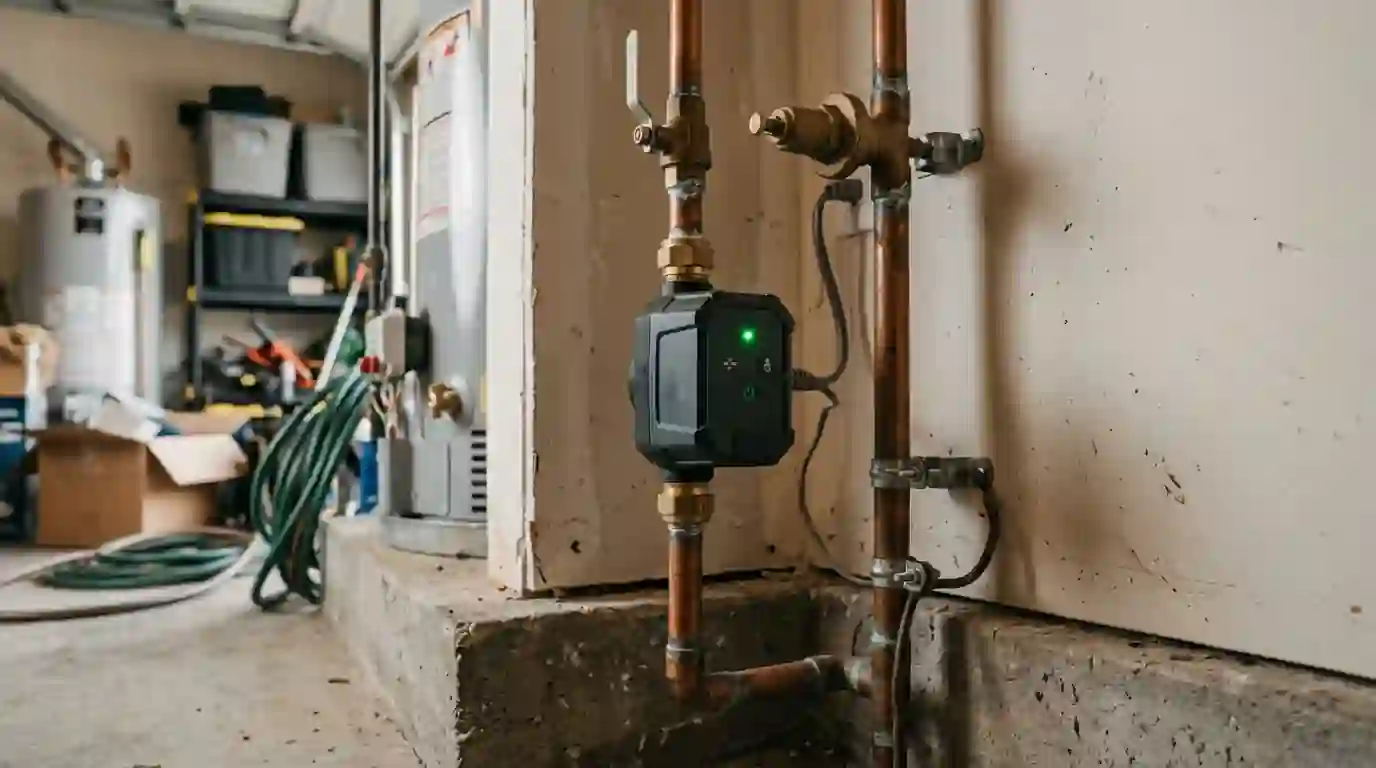
The valve goes on the main line inside the house, usually in the garage near the water heater, downstream of your manual shut-off so you can still isolate it. A small motor turns a ball valve closed when it's told to. We cut it into the line with unions so it can be serviced, mount it level, and leave the manual valve working beside it. Plan for an outlet within reach, and check that your sprinkler line tees off before or after it depending on whether you want irrigation covered.
Flow monitors on the main
A flow monitor measures every gallon going into the house and learns what normal looks like: showers in the morning, laundry on weekends, a softener regenerating at night. When a flow runs far longer than usual, it alerts you or closes the valve. Many also run a short pressure test overnight to catch drips too small to see. Monitors that clamp onto the outside of the pipe only report; the ones that can shut off water are cut into the line.
Water sensors at heaters and sinks
Battery sensors sit on the floor where leaks start: in the water heater pan, under the kitchen and bathroom sinks, behind the washer, beside the refrigerator's ice maker line and under the attic air handler. When water touches the contacts, the valve closes. Sensors only see water that reaches them, so placement matters more than the count. We place them at the low point beside each appliance, then test each one with a damp cloth so you know it triggers the valve.
Phone alerts and away mode
The app tells you when a sensor trips, when flow looks wrong and when the valve closes, and lets you close it from anywhere. Away mode tightens the rules, so almost any flow while you're gone shuts the water. Before you rely on it, ask what happens when the internet drops: some systems still close on a sensor alarm locally, others need the cloud. We set up the app with you and run a test closure, so the first alert you get isn't a surprise.
Local conditions
The February 2021 freeze is the clearest local case for these valves. City data showed 311 residential structures in Friendswood were affected by Winter Storm Uri. A University of Houston Hobby School survey found that 38% of Harris County residents suffered water damage from burst pipes during that storm. A valve can't keep a pipe from freezing, but a break that opens while nobody is home keeps running until someone closes the main, and an automatic valve closes it as soon as a sensor trips.
Sources: communityimpact.com, uh.eduHow an automatic shutoff goes in
- Check the mainWe look at where the line enters, its size and material, and whether the manual valve still closes.
- Cut in the valveThe motorized valve goes in downstream of your shut-off, with unions so it can be serviced later.
- Place the sensorsSensors go at the low point beside each heater, sink, washer and air handler.
- Test and hand overWe trigger each sensor, confirm the valve closes and set up the app with you.
Questions about smart water shutoff installation in Pearland
Flow-monitoring systems learn your normal use and let you set how long a single flow may run. A long soak or filling a pool may need a pause in the app, which takes a tap.
Most motorized valves need power to close, and many stay in their last position during an outage. Some systems include battery backup. If yours doesn't, closing the manual main before a long trip is still wise.
Yes, and it's the right time to replace a main valve that sticks or won't close fully, since the line is already open. See our shut-off valve replacement page for what that involves.
It limits the damage after a frozen pipe splits, but it doesn't stop the freeze. Some sensors report low temperatures, which gives you warning. Insulating exposed lines is the prevention; see pipe freeze protection.
Sensor-only kits that alert without closing anything are a homeowner install. Any valve cut into the main means draining the system, joining pipe under full pressure and testing for leaks, which is plumbing work.