Updated October 2026
Quick answer
For a Pearland area home on a private well, most outages trace to the pressure switch, the pressure tank or the pump. A gauge reading at the tank and an amp reading on the pump circuit usually show which part failed, so the pump only comes out of the well when it is the problem.
Signs your well system needs attention
- The pump clicks on and off every few seconds while a tap runs
- Faucets spit air or pressure fades mid-shower
- The gauge never climbs back to its usual cut-out pressure
- Sand, grit or cloudy water appears suddenly
- The pump runs nonstop or the breaker keeps tripping
How we track down a well problem
- Read the systemWe watch the gauge through a full cycle and note cut-in, cut-out and run time.
- Test the electrical sideVoltage at the switch and amps on the pump circuit show whether the motor is healthy.
- Repair the failed partThe switch, tank, control box or pump is replaced and settings are matched to the tank.
- Restore and sanitizeWe bring pressure back up, check for leaks and disinfect the well when the pump was pulled.
A well system is simple on paper. The pump pushes water into a pressure tank, and a switch starts the pump at a low pressure and stops it at a higher one, often 40 and 60 psi. The tank's air cushion lets you draw water without the pump starting every time a tap opens.
When one part fails, the others suffer. When the tank loses its air, the pump starts and stops constantly, and that short cycling burns out motors. So we check the whole chain, not just the part that quit last.
No water from the well
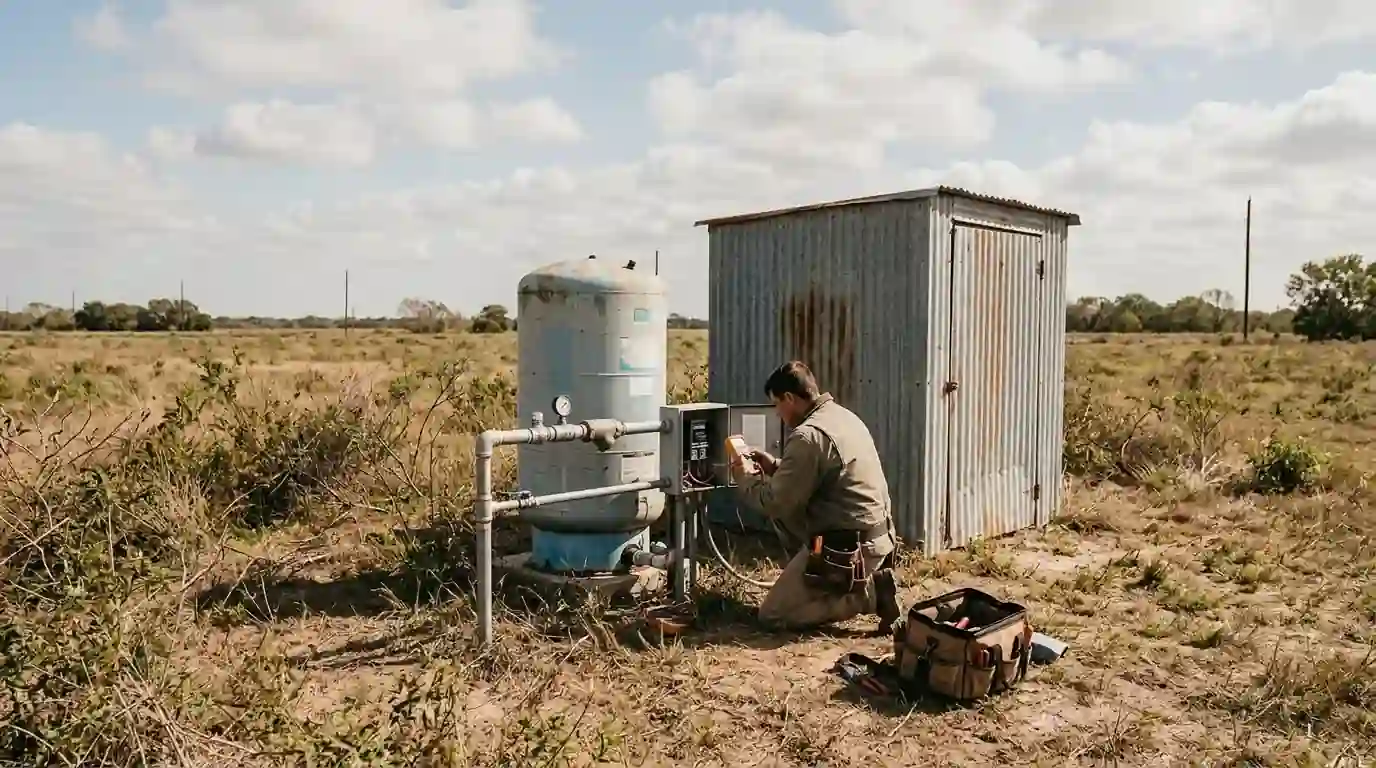
Start with the breaker: if it tripped, reset it once and watch the pressure gauge. A second trip means leave it off. We check voltage at the pressure switch, then the control box on three-wire pumps, where a failed capacitor or relay is a common culprit. An amp reading tells us whether the motor is running, locked or open. If the pump spins but moves no water, the cause may be a split drop pipe, a failed check valve or a low water level.
Waterlogged pressure tank
A waterlogged tank has lost its air cushion, so the pump clicks on and off every few seconds while a tap runs and the gauge needle jumps. Older plain-steel tanks lose air over time; bladder tanks fail when the bladder tears. We drain the tank with the pump off and check the air charge, which should sit about 2 psi below the cut-in pressure. If water comes out of the air valve, the bladder is gone and the tank needs replacing. Fixing this early protects the pump.
Water still running? Call before it spreads.
Call (281) 845-9645Pressure switch failure
The pressure switch carries full pump voltage across contacts that open and close every cycle. Over time they pit and burn, and the pump may chatter, refuse to start or run without shutting off. The small tube under the switch can also clog with sediment, so the switch never sees the real pressure. We replace the switch, clear the fitting under it and set cut-in and cut-out to match the tank. A low-pressure cutoff switch can protect a pump that runs dry.
Submersible pump replacement
When readings point to the pump, it has to come up with its drop pipe and wire, which takes the right equipment and a clear path around the wellhead. We match the new pump to your well's yield and the house's demand rather than just the old nameplate. The check valve, wire splice and torque arrestor are replaced at the same time, and worn drop pipe or wire gets replaced while it is out. Afterward the well is disinfected and you should have the water tested.
Local conditions
Groundwater around Pearland is managed, not just pumped. The Brazoria County Groundwater Conservation District's management plan says growth particularly in the Pearland area is faster than anticipated. Across the line in Friendswood and the rest of the Harris-Galveston Subsidence District, rules cap groundwater at 10% of total demand in Regulatory Area One and 20% in Area Two. Rules differ by district and well size, so check with yours about what applies before a private well is deepened or replaced.
Sources: twdb.texas.gov, hgsubsidence.orgWhat decides the cost of a well pump repair
We price the job after testing at the well, because one symptom can mean a small switch or a pump pulled from depth.
- Which part failed. A pressure switch or capacitor is a small repair; a tank or a pump is a bigger one.
- Pump type and depth. A deep submersible takes more time and equipment to pull than a shallow jet pump.
- Condition of pipe and wire. Corroded drop pipe or cracked wire found during a pull is replaced before the pump goes back.
- Access at the wellhead. Fences, slabs or plantings over the well slow the pull.
Safe checks for you, and the jobs for us
What you can do safely
- Reset a tripped pump breaker once, and leave it off if it trips again
- Note the gauge reading when the pump starts and stops
- Listen for rapid clicking at the tank while a tap runs
- Keep the well cap sealed and the wellhead clear
When to call a plumber
- Pressure switch work, because the contacts carry live pump voltage
- Tank replacement and setting the air charge
- Motor and control box testing
- Pulling and setting a submersible pump
Questions about well pump repair & replacement in Pearland
Rapid cycling almost always means the pressure tank has lost its air charge or its bladder has failed. The pump starts every time a little water is drawn, which wears the motor fast. Have the tank checked soon.
It can signal trouble in the well, such as a pump set too low, a damaged screen or a falling water level. A sediment filter helps, but find the cause before sand wears out the pump.
Not automatically. When the tank holds its air charge and the bladder is intact, it can stay. If it is waterlogged or rusting at the base, replace it now to protect the new pump from short cycling.
Yes, whenever the pump was pulled or the well was opened. We disinfect the well after the work, and a bacteria test from an accredited lab confirms the water is safe to drink again.
Rarely by itself, but voltage spikes and repeated restarts as power flickers back can stress the motor and control box. If the pump will not restart afterward, check the breaker once, then call.