Quick answer
For most Pearland homes a tank water heater costs less to install and replace, while a tankless unit costs more upfront but delivers continuous hot water and takes less space. The deciding questions are your gas supply, where vents can run, how many showers run at once and whether you'll descale the unit every year on local water.
How each type makes hot water
A tank heater keeps 40, 50 or more gallons hot around the clock and refills with cold water as you draw it down. When the tank runs out, you wait while the burner or elements reheat the new water. Standby loss, the heat that leaks out of a full tank between uses, is part of the cost of owning one.
A tankless heater stores nothing. When a faucet opens, a flow sensor fires a large burner or bank of elements that heats water as it passes through a heat exchanger. You never run out, but the unit has a ceiling on how many gallons per minute it can heat at once, and that ceiling drops as the incoming water gets colder.
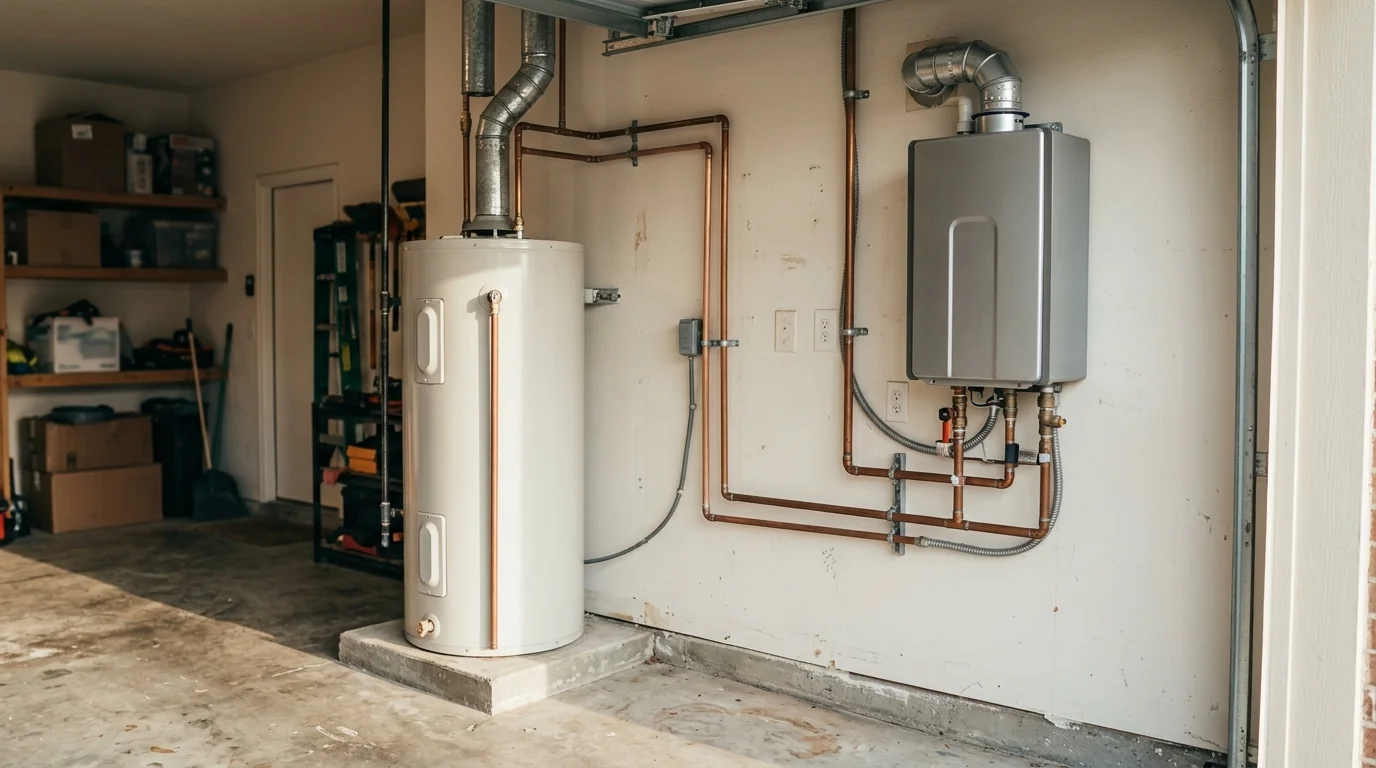
What the switch to tankless takes in a typical house
The unit is only part of a tankless conversion. Most of the extra work sits in the supply lines and venting that a tank never needed, and that's where quotes for the same model can differ widely.
- A gas line sized for the burner's full demand, often larger than the line that fed the old tank
- New venting, usually stainless or PVC run through a wall or the roof, since the old flue rarely works
- A condensate drain and neutralizer on high-efficiency condensing models
- An electrical outlet for the controls and fan, even on gas units
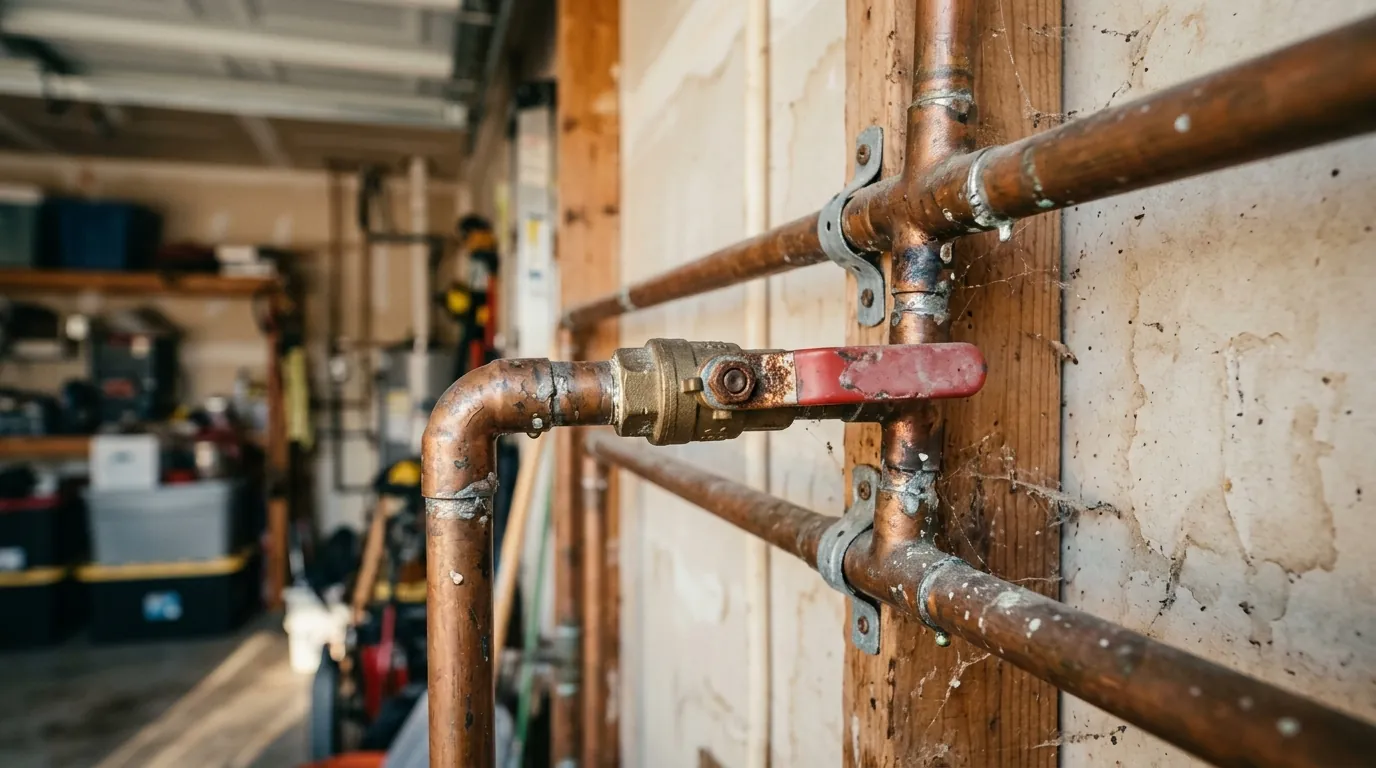
- Isolation valves for yearly descaling, which we add as part of the install
Code and permits apply to both choices
The City of Pearland's adopted codes include the 2021 International Plumbing Code, 2021 International Residential Code and 2021 International Fuel Gas Code, with local amendments to the plumbing and fuel gas codes. In practice that means gas pipe sizing, vent clearances, combustion air and relief valve discharge all get checked on inspection, whichever heater you choose.
For a tank swap the code items are familiar: pan, relief line, expansion tank, venting. For tankless the gas sizing and vent route are the big ones. Neighboring cities such as Friendswood follow their own adopted codes, so we check the local requirements on every install.
Rather have a plumber look at it?
Call (281) 845-9645How local water treats each type
Pearland's water quality report lists chloramines as the primary disinfectant (average 3.143 ppm) and total dissolved solids averaging 321 ppm (range 321-522 ppm) for the city system, versus 271 ppm in the City of Houston supply. Houston's 2025 Water Quality Report puts total hardness averaging 135.5 ppm (range 43.5-229) for the main system. Water in that range leaves mineral scale wherever it's heated.
In a tank, scale settles to the bottom as sediment, which you can flush out with a hose. In a tankless unit it coats the narrow passages of the heat exchanger, cutting flow and tripping error codes. That's why tankless owners here should plan on descaling with a pump and vinegar or descaler solution once a year, or install a softener or scale-reduction filter upstream.
Side by side: the tradeoffs that decide it
Neither type wins everywhere. These are the points we walk through with homeowners before they choose.
- Upfront: tanks cost less to buy and install; tankless costs more, mostly because of gas and venting work
- Hot water supply: tanks can run out during back-to-back showers; tankless won't run out but can struggle with three fixtures at once
- Space: a tankless unit hangs on a wall and frees a closet or attic platform
- Operating cost: tankless avoids standby loss, so it uses less fuel for the same hot water
- Upkeep: tanks need a yearly flush and an anode check; tankless needs yearly descaling
- Power outage: a gas tank with a standing pilot still heats; most tankless units need electricity
When a tank still makes more sense
If your gas service is small and upsizing the line means a long run through a finished house, the conversion cost can swamp any savings. The same goes for a house where the only vent path is awkward or a rental you don't plan to keep long. For a household that rarely runs two showers at once, a well-maintained 50 gallon tank does the job at a lower total cost.
When the tank you have is failing, a straight water heater replacement is also the quickest way back to hot water. It keeps the same fuel, the same vent and usually the same footprint.
When tankless, or a heat pump tank, earns its cost
Tankless pays back best in homes with a gas line that can already handle the load, a straightforward vent route, larger families and owners who plan to stay. It's also a strong pick where space is tight, since it frees the closet or attic platform. Our tankless water heater installation page explains how we size the unit to your fixtures.
There's a third option for all-electric homes. A heat pump water heater keeps the tank but moves heat from the surrounding air into the water, using a fraction of the electricity of standard elements. It needs room for airflow and a condensate drain, and in a warm garage it runs especially well.
Repairs this guide points to
- Tankless Water Heater InstallationTank to tankless conversion, Gas line and venting upgrades
- Water Heater Replacement40 and 50 gallon tank swaps, Attic water heater replacement
- Heat Pump Water Heater InstallationGarage installs, Condensate drain routing
Reader questions
It won't run out the way a tank does, but each unit has a maximum flow rate. Run a shower, the dishwasher and the washing machine together, and an undersized unit will send lukewarm water to all three. Sizing to your fixtures prevents that.
Often, but not always. The old flue usually can't serve a tankless unit, and the gas line may be too small. Many owners move the unit to an exterior wall to shorten the vent run and reclaim the old closet.
You don't strictly need one, but scale is the main cause of tankless trouble on mineral-heavy water. A softener or scale-reduction filter upstream cuts how often you descale and protects the heat exchanger, which is the most expensive part to replace.
Sometimes not. With lighter hot water use, the fuel savings take longer to cover the higher install cost. If the existing tank location works and you aren't short on space, a new tank is usually the more sensible choice for a small household.
Yes. A like-for-like tank swap is quicker because the gas, vent and water connections are already in place. A tankless conversion adds gas line work, a new vent and often a new location, so it runs longer and usually adds inspection items.
Most don't, because the controls, igniter and venting fan need electricity even on gas units. A gas tank with a standing pilot keeps heating without power, which some Gulf Coast homeowners weigh heavily after storm outages.
Keep reading
- Freeze-Proofing Pipes After the 2021 StormWhat the February 2021 freeze taught Houston-area homes about attic lines.
- Repiping an Older Pearland Home: What to ExpectSigns your pipes are due, PEX versus copper, and how a repipe day runs.
- Burst Pipe in Pearland: What to Do FirstThe first ten minutes: the valve, the heater, the lowest faucet, then the call.