
Quick answer
In Pearland, every backflow-prevention assembly has to be tested when it's installed, and assemblies protecting against a health hazard must be tested every year. That rule comes from TCEQ and is restated on Pearland Water's backflow prevention page. A new irrigation system also needs a city permit before installation, with separate permits for the plumbing work.
What a backflow preventer protects you from
Water in the city main is under pressure, and it normally flows one way: into your property. Backflow is what happens when that flow reverses. A main break or heavy draw from a hydrant can drop street pressure and siphon water back out of your lines. A pump or boiler on your side can push water back toward the main. Either way, whatever is connected to your plumbing can travel with it.
A cross-connection is any point where drinking water meets something it shouldn't, such as a sprinkler head sitting in fertilized soil, a boiler loop or a chemical feeder. The backflow assembly sits between your system and that hazard, using spring-loaded check valves and, on some designs, a relief valve that dumps water rather than let it reverse.
The two testing rules Pearland Water points to
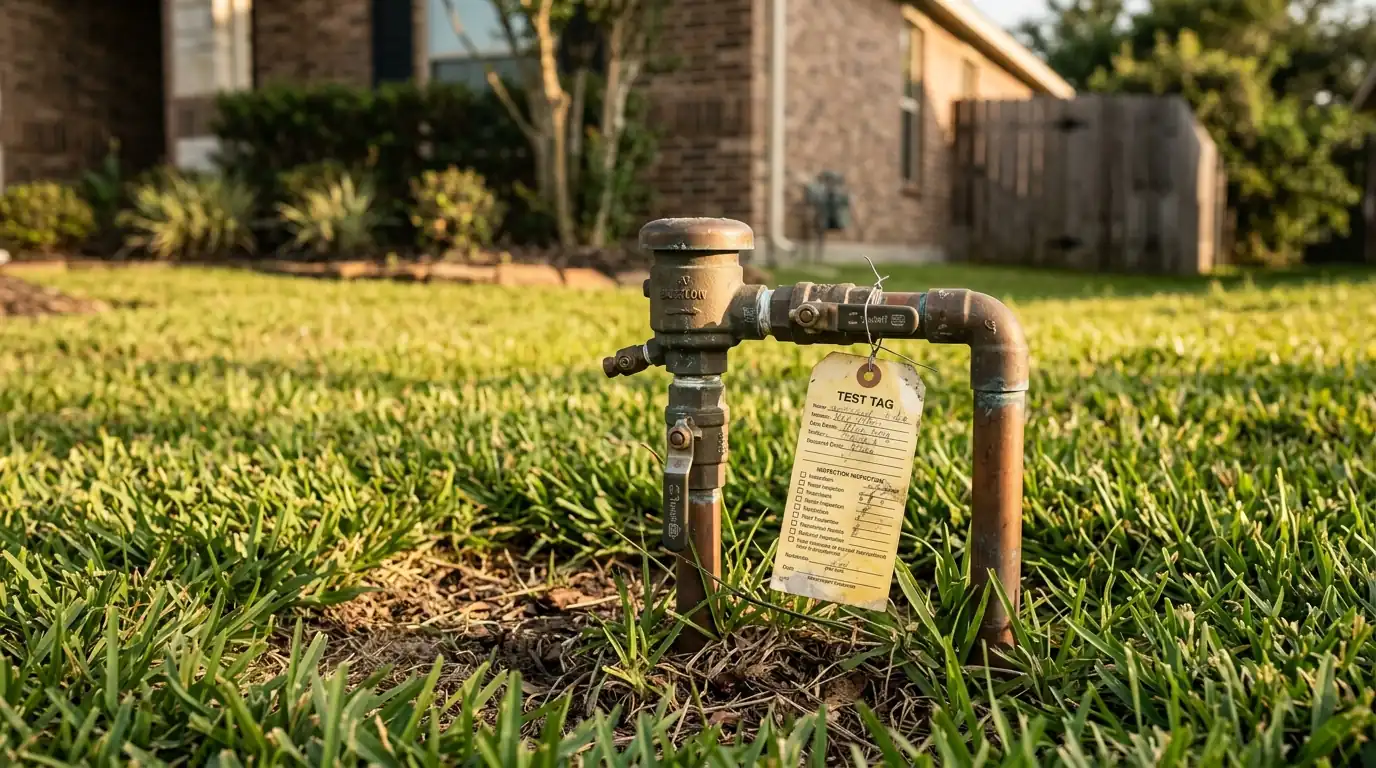
Pearland Water's backflow prevention page states that TCEQ requires all backflow-prevention assemblies to be tested at installation by a TCEQ-recognized tester, and that assemblies protecting against a health hazard must be tested annually. That gives you two triggers to remember: a test when an assembly goes in, and a yearly test after that if the hazard it guards is a health hazard.
Whether your assembly falls into the annual group depends on what it protects. Lawn water can carry fertilizer, pesticide residue and pet waste, and commercial equipment can hold chemicals or treated water. If you're not sure how your assembly is classified, ask Pearland Water directly before the anniversary of the last test.
Permits for irrigation and the plumbing behind it
Pearland's irrigation permit sheet states that a permit is required before an irrigation system is installed and that separate permits are required for plumbing work. In practice, the sprinkler layout and the tie-in to your water supply are treated as separate pieces of work, so plan for both before anyone starts trenching.
The code side matters too. The City of Pearland's adopted codes include the 2021 International Plumbing Code, 2021 International Residential Code and 2021 International Fuel Gas Code, with local amendments to the plumbing and fuel gas codes. The plumbing code sets which type of assembly fits which hazard and how it has to be installed, so the device on your irrigation line isn't a matter of taste.
Rather have a plumber look at it?
Call (281) 845-9645Common assembly types you'll see on Pearland properties
The assembly on your property depends on the hazard and the installation. These are the ones that come up most on homes and small businesses:
- Reduced pressure zone assembly (RPZ): two check valves with a relief valve between them, used where the hazard is highest; it must sit above ground with room to drain
- Double check valve assembly: two independent check valves, used for lower hazards and often installed in a ground-level box
- Pressure vacuum breaker (PVB): a single check and an air inlet, common on irrigation and installed above the highest sprinkler head
- Hose bib vacuum breaker: the small screw-on device on an outdoor faucet; it isn't a testable assembly
What happens during a test visit
A backflow test takes place at the assembly itself, so the tester needs clear access to it. Water to the protected system is off for part of the visit. Here's how a typical test runs:
- The tester confirms the assembly's make, model, size and serial number
- The downstream shutoff is closed so the assembly can be tested without flow
- A differential pressure gauge is connected to the test cocks on the assembly
- Each check valve, and the relief valve or air inlet, is checked against its required reading
- Results go on a test report for the water provider, and you keep a copy
- The valves are reopened and the system is checked for normal flow
Why assemblies fail, and what the fix involves
Most failed tests come down to small parts. Grit or scale lodges on a check valve seat so it can't close tight, a rubber disc or diaphragm wears out, or a spring weakens. A hard freeze can crack a body or bonnet on an assembly that sits above ground without a cover. An RPZ that drips or spits water from its relief port is often showing a check valve problem before the test even starts.
Many failures are fixed with a cleaning and a rebuild kit, followed by a retest so the passing result can be reported. A cracked body, a discontinued model or an assembly in the wrong place usually means replacement. Our backflow preventer installation page covers swapping and relocating assemblies, and backflow testing walks through a test visit.
Restaurants, offices and other businesses
Commercial buildings tend to carry more assemblies than a house: one on the main service, others on fire sprinkler lines, boilers, irrigation, and equipment like soda dispensers and dish machines. Each one can have its own test date, and losing track of them is how a business ends up with a notice from the water provider. Keep a simple list of every assembly, where it is and when it was last tested.
If you're opening or remodeling a space, plan the assemblies with the rest of the plumbing so they land somewhere accessible and above ground where the type requires it. Our commercial plumbing work covers those layouts.
Repairs this guide points to
- Backflow Testing & CertificationAnnual irrigation backflow tests, Commercial assembly tests
- Backflow Preventer InstallationRPZ assemblies, Double check valves
- Commercial PlumbingRestaurants, Offices and retail
Reader questions
If your irrigation system has a testable assembly, it was required to be tested when installed. Assemblies protecting against a health hazard need a test every year. Ask Pearland Water how yours is classified if you haven't had a notice.
Pearland Water's page says assemblies must be tested at installation by a TCEQ-recognized tester. Ask whoever does the work to confirm that status before the test, and keep a copy of the completed test report for your records.
Rules on follow-up vary, so check any notice you receive for the deadline it gives. Skipping the test also leaves you without any check that the device still works, which matters on a system tied into lawn chemicals or equipment.
A small discharge from an RPZ relief port during a pressure swing can happen, but a steady drip or stream usually means a check valve isn't sealing. Have it inspected and tested, since that discharge is the device signaling a problem.
Pearland's irrigation permit sheet says separate permits are required for plumbing work, so check with the city's permit office before replacing an assembly, and plan for a test once the new one is in.
Yes. Above-ground assemblies hold water in thin brass parts that crack in a hard freeze. Use an insulated cover, or shut off and drain the irrigation assembly following its maker's directions before a freeze.
Keep reading
- Repiping an Older Pearland Home: What to ExpectSigns your pipes are due, PEX versus copper, and how a repipe day runs.
- Why Drains Back Up After Heavy Rain in PearlandWhat heavy rain does to sewer lines, and the backwater valve that helps.
- Do You Need a Water Softener in Pearland?What Pearland and Houston water reports say, and softener versus carbon filter.