Quick answer
Expect a repipe in an older Pearland home to replace every supply line from the main to each fixture, usually with PEX run through the attic and walls instead of under the slab. The work happens in stages, the drywall openings are small and get patched, and the old lines are capped and left in place rather than dug out.
How old is the plumbing in your part of Pearland?
Much of Pearland is fairly new, but not all of it. In the Pearland ISD area (ACS-ED 2019-23), 42.6% of housing was built in 2000 and after, 51.5% between 1970 and 1999 and 5.9% before 1970. That middle group is the one to watch: a house from the 1970s or 1980s has supply pipe that has been in service for four or five decades.
Subdivision data from HAR shows the spread. On the east side, several older subdivisions show average build years between 1964 and 1978. Elsewhere in town, a few subdivisions average 1973 and 1974, while Shadow Creek Ranch averages 2005 and 2013 across its two county sections, and one recent subdivision in that table averages 2023. A repipe question in a 1970 ranch house and one in a 2013 build are not the same question.
Pipe materials you're likely to find by decade
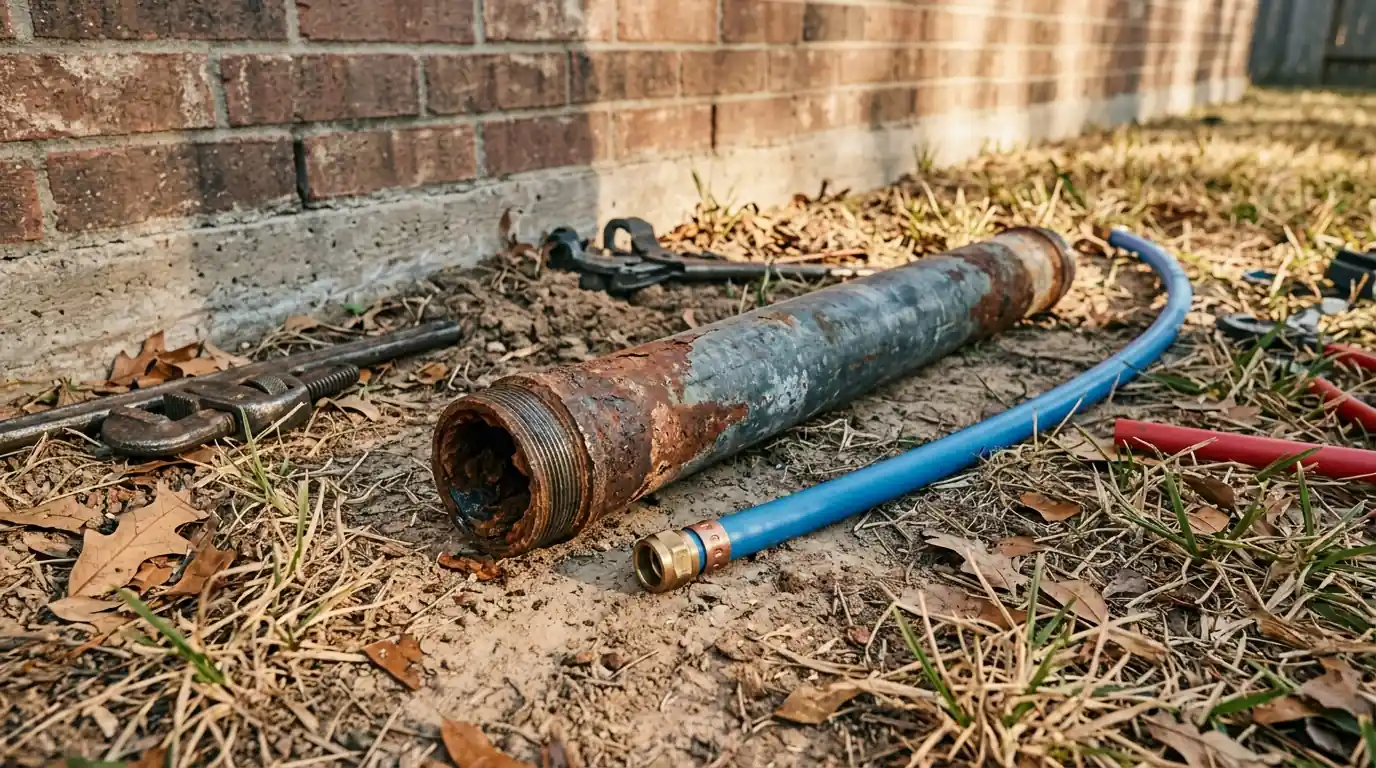
The year your house was built tells us roughly what's inside the walls before we open anything. It's only a starting point, since earlier owners may have patched sections with whatever was on hand. Here's what usually turns up:
- 1960s homes: galvanized steel supply lines are possible, and cast iron drains are common
- 1970s homes: copper supply, often run under the slab, with cast iron or early plastic drains
- Late 1970s to mid-1990s: polybutylene, a gray plastic supply pipe known for failing at fittings, shows up in some houses
- 1990s and later: copper or CPVC supply with PVC drains, and PEX becoming common in newer builds
Warning signs that patching has stopped making sense
One leak is a repair. A second or third leak on the same system tells you the pipe itself is wearing out, and every new patch buys less time than the one before. Watch for these signs:
- Pinhole leaks showing up in different rooms within a year or two
- Brown or rusty water at the first draw of the morning
- Pressure that drops when two fixtures run at once
- Green or white crust on exposed copper under sinks and at the water heater
- A second slab leak on lines that run under the concrete
Rather have a plumber look at it?
Call (281) 845-9645PEX or copper for the new lines
PEX is the usual choice for a repipe. It bends around framing, so a run from the attic down to a bathroom needs fewer joints, and it tolerates a hard freeze better than rigid pipe because it can swell slightly instead of splitting. Its weak point is sunlight, so it has to stay out of direct UV, and the fittings must be crimped or expanded with the right tool.
Copper still makes sense for exposed runs, at the water heater connections and for homeowners who want metal throughout. It takes more joints and more labor, and on the Gulf Coast it still has to be protected where it passes through the attic. We'll price both if you ask, and walk you through where each one fits.
How a repipe day runs in an occupied house
Most families stay home during a repipe. We cover floors and furniture in the work areas, then make small openings in drywall where the new line drops from the attic to each sink, tub, toilet and appliance. The new system goes in alongside the old one, so water stays on for much of the job.
The switchover is the part that interrupts your day. We cut the house over to the new lines, cap the old ones, pressure-test the new system and check every fixture for flow and leaks. Then the drywall openings get patched. We go over the schedule with you before work starts, including when the water will be off, and handle the permit and inspection the job calls for. Our whole-house repiping page walks through the scope in more detail.
Drains and the yard line deserve a look at the same time
A supply repipe doesn't touch the drains. In a house from the 1960s or 1970s, the cast iron under the slab is just as old as the supply pipe, and it fails differently: it scales, cracks and lets roots in. A camera run through the main cleanout before the repipe shows whether cast iron drain replacement belongs on the same plan.
The line from the meter to the house is the other piece. If it's galvanized or old copper on clay soil, replacing it during the repipe saves opening the yard twice. Ask about water line repair if that line is the same age as the house.
What you can do before calling
A little homework makes the first conversation faster and the estimate more accurate. None of it needs tools or a permit. You can:
- Look under the kitchen sink and at the water heater to see what pipe is exposed
- Write down the dates and rooms of past leaks, plus any slab repair receipts
- Find the main shutoff and confirm it closes fully
- Note any rooms with low pressure or discolored water
- Check whether the attic has room to walk and any flooring you want protected
Repairs this guide points to
- Whole-House RepipingPolybutylene pipe replacement, Galvanized pipe replacement
- Cast Iron Drain ReplacementUnder-slab cast iron, Tunneling vs breaking the slab
- Water Line Repair & ReplacementLeak between the meter and the house, Low pressure from an old service line
Reader questions
Usually not. Most families stay home, since the new lines go in while the old system keeps running. Plan for the switchover period without water, a bit of dust near the openings, and people moving through the attic and the rooms being worked on.
No. A standard repipe runs the new lines through the attic and down inside the walls. The old lines under the slab are capped and stay in the ground, so the concrete stays closed. Drywall openings are small and get patched.
PEX made for potable water is rated for that use and is widely installed in homes across the country. It does need protection from sunlight, and fittings must be installed with the correct tool. Some homeowners still choose copper for its long track record.
Polybutylene is usually gray, sometimes blue, and often stamped PB2110 on the side. Look where pipe comes out of the wall under sinks or at the water heater. If you're unsure, send us a photo or have us check during a visit.
Yes, if the problem stays in one area, such as a kitchen line or the lines under one bathroom. If the house is old enough for pipe to wear out everywhere, a partial repipe often leads to the next leak in a section that wasn't replaced.
It's uncommon. A newer home is more likely to need a single fitting or a defective valve replaced. Repeat leaks in a house built after 2000 point to a specific defect or installation problem, and we'd look for that before suggesting a repipe.
Keep reading
- Freeze-Proofing Pipes After the 2021 StormWhat the February 2021 freeze taught Houston-area homes about attic lines.
- What a Water Heater Replacement Costs in Pearland, TXSourced price ranges, what pushes a quote up, and when repair still makes sense.
- Hydrostatic Plumbing Tests Before Foundation RepairWhy foundation companies ask for a drain test on clay, and how it is done.