
Quick answer
A hydrostatic plumbing test shows whether the drain lines under your slab are leaking, so foundation repair doesn't treat the symptom while water keeps undermining the soil. The plumber plugs the sewer at the cleanout, fills the drains with water to the floor level and watches the level for a set time. If the water drops, a drain is leaking somewhere below.
Why foundation companies want the drains checked first
A slab settles or heaves when the soil under it changes, and leaking drain water is one of the things that changes it. If a cracked drain keeps soaking one corner of the clay, piers can lift the slab back into place and it will still move again once the soil there swells or washes out.
That's why many foundation contractors, and many buyers' inspectors in a home sale, ask for a hydrostatic test before they bid or start work. It answers a simple question: are the drains under this house holding water or not. A pass lets the foundation work go ahead with one variable removed. A fail means the plumbing gets fixed first.
The clay under Pearland and its neighbors
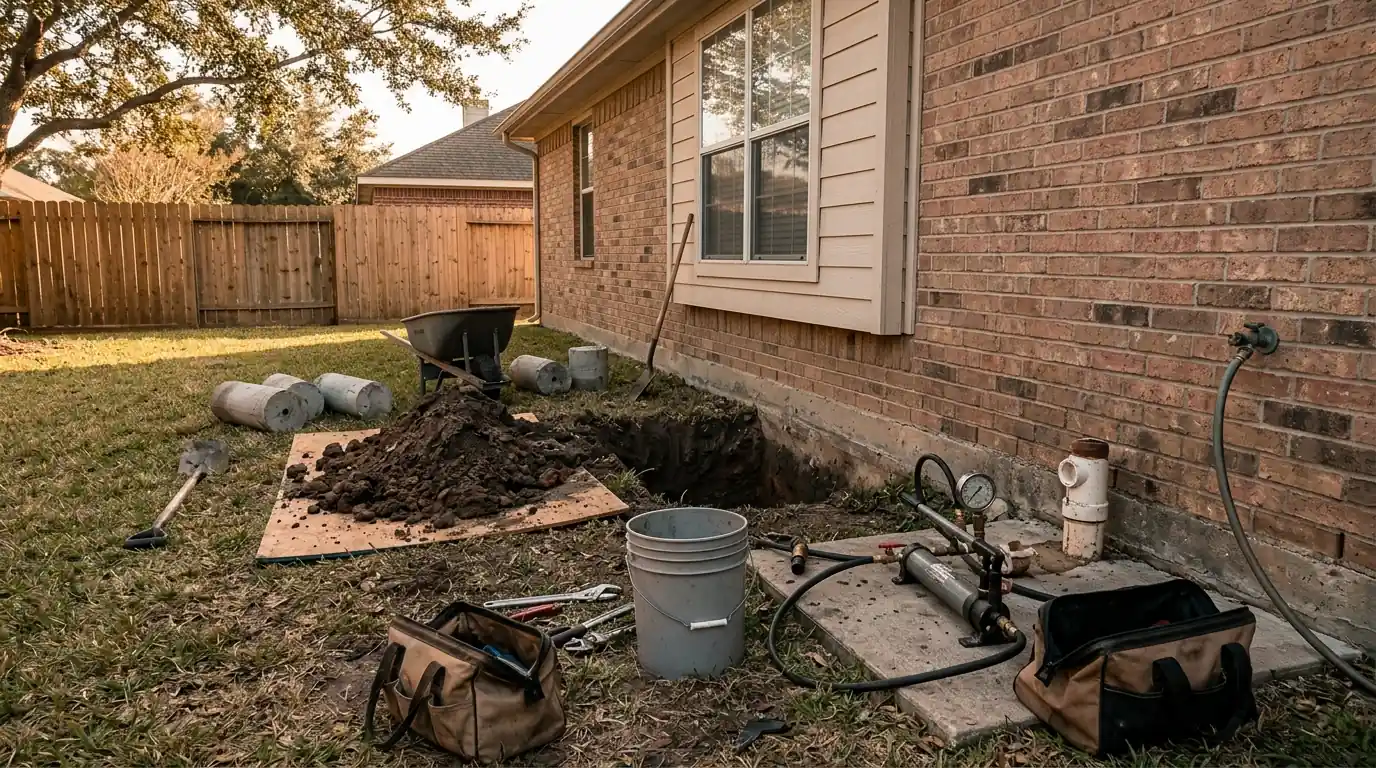
Local soil is the reason this test comes up so often. USDA's Lake Charles soil series forms in clayey deposits of the Beaumont Formation, is extensive in Southeast Texas between the Colorado and Trinity Rivers, has very slow permeability and develops cracks 1 to 5 cm wide reaching 30 cm or more when dry. That clay runs under homes in Brazoria County and across the Houston side of the region.
West of Pearland the picture is similar. USDA's Bernard soil series covers about 500,000 acres of the Coastal Prairie of Texas and Louisiana, has its type location in Fort Bend County and is somewhat poorly drained with very slow permeability. Homes in Missouri City and Sugar Land sit on that kind of ground. Houston Geological Society writing on the Beaumont Formation says structures on its expansive soils have built-in construction and maintenance problems, and buried drain pipe is part of the structure.
How the test is done, step by step
A hydrostatic test is simple in principle and fussy in practice. The house can't use water while it runs, so plan on staying out of sinks, tubs and toilets until we say the lines are open again.
- We locate the main cleanout and insert an inflatable test ball to seal the sewer where it leaves the house.
- Water is added through a toilet flange or cleanout until the drains are full to just below the floor.
- We mark the level and wait, usually watching it for a set period while checking for water surfacing anywhere.
- If the level holds, the system passes. If it drops, we split the system with additional plugs to narrow which branch is losing water.
- The test ball is removed and the water released down the sewer once the readings are recorded.
Rather have a plumber look at it?
Call (281) 845-9645Reading the results, and what happens on a fail
A steady level means the drains under the slab are holding at the test height. A small drop can come from a toilet wax ring or a loose test plug, so we check those before calling it a leak. A clear, continuing drop means a drain is open below the floor.
Finding where comes next. A sewer camera inspection runs a camera through the lines to look for cracks, separated joints or bellies, and lets us mark the spot on the floor above. From there the fix may be a section repair through the slab, a tunnel from outside or a liner, depending on the pipe and the location.
Cast iron, PVC and why age matters
Older homes in the region were plumbed with cast iron drains, which corrode from the inside, scale up and eventually crack along the bottom of the pipe where water sits. On shifting clay those weak spots open faster. When a test fails on cast iron and the camera shows widespread scaling, patching one spot rarely ends the problem, and cast iron drain replacement becomes the conversation.
Newer homes with PVC drains tend to fail at joints instead, where soil movement has pulled a fitting apart or cracked a hub. Those are usually spot repairs. Either way, the test result and the camera footage give the foundation company the information they asked for.
Getting the order of trades right
The cleanest sequence is plumbing test, any plumbing repair, then foundation work, then a retest if the foundation contractor wants proof that leveling didn't stress the drains. Lifting a slab can shift pipes that were fine before, so a follow-up hydrostatic plumbing test after the piers are set is worth asking about.
Share the written results and camera video with everyone involved: the foundation contractor, your insurance agent if a claim is open, and the other side of a home sale if one is in progress. It saves each of them from ordering their own test.
What a homeowner can check before the test
You can't run a hydrostatic test yourself, but you can gather clues that help us read the result. Note any drains that gurgle or empty slowly, toilets that rock, damp spots along a wall that shares plumbing, or a sewer smell in one room. Find your cleanout, usually a capped pipe near the foundation outside or in the yard, and clear plants or mulch away from it so the test ball can go in without digging.
Repairs this guide points to
- Hydrostatic Plumbing TestBefore foundation repair, After foundation lifting
- Cast Iron Drain ReplacementUnder-slab cast iron, Tunneling vs breaking the slab
- Sewer Camera InspectionPre-purchase sewer scope, Repeat clog diagnosis
Reader questions
No. A hydrostatic test checks the drain and sewer lines, which aren't pressurized, by filling them with standing water. A pressure test checks the supply lines that carry water to fixtures. Foundation companies typically ask for the drain test.
Sound pipe holds the test water without trouble because the level stays below the floor. The test only shows weaknesses that already exist. The main precaution is not running water during the test, which could back up through a floor drain.
That's set by the contract and the negotiation, not by the plumber. Buyers often order it during the option period, and sellers sometimes order one upfront to answer questions early. Either way, the written results can be shared.
Yes. A pass means the lines held water at the test height during the test. It doesn't show roots, bellies or heavy scale that slow drainage without leaking. A camera inspection fills that gap if the drains are acting up.
No. Only the drains are out of service, but fixtures can't be used because the water has nowhere to go. Plan to be out of the bathrooms and kitchen for a good part of the day. Running water elsewhere can push the level up and spoil the reading.
It's worth asking for, especially on older pipe. Raising a slab with piers can pull or crack a drain joint that held before. A short retest after the work confirms the plumbing came through the lift intact.
Keep reading
- Freeze-Proofing Pipes After the 2021 StormWhat the February 2021 freeze taught Houston-area homes about attic lines.
- Repiping an Older Pearland Home: What to ExpectSigns your pipes are due, PEX versus copper, and how a repipe day runs.
- Tank vs Tankless Water Heaters for Pearland HomesUpfront cost, gas line and venting needs, and how each handles Pearland water.