
Quick answer
A water heater replacement in Pearland is priced mostly by fuel type, tank size, where the heater sits and how much code work the old install needs. A like-for-like gas or electric tank in an open garage is the simplest job; an attic unit, a fuel change or a move to tankless adds parts, labor and sometimes a gas line upgrade.
The published price ranges, and how to read them
The table on this page pulls planning ranges from national cost guides and Houston-area data, covering standard tank replacements, water heater repairs and tankless installs. Treat them as a starting point, not a quote. The low end of any range usually describes a straight swap with easy access and no code catch-up; the high end covers larger tanks, harder locations and conversions.
Your own number comes from a look at the heater, the space around it, the gas or electric supply and the venting. We give you that price before any work starts, and we'll tell you if a repair makes more sense than a new unit.
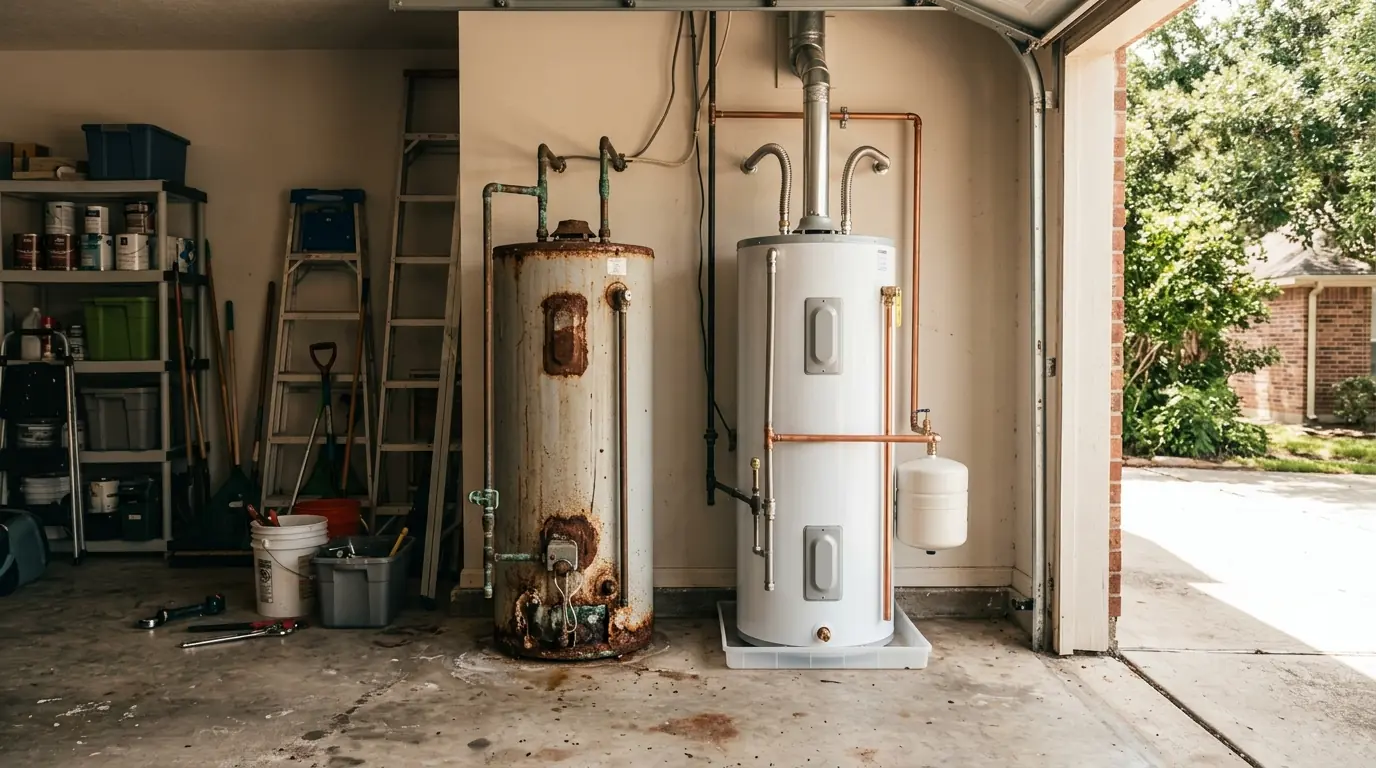
Fuel type and tank size set the baseline
Most homes run either a 40 or 50 gallon tank, gas or electric. Gas units cost more to buy because they carry a burner, a gas valve and a flue, while electric tanks are simpler but can take longer to recover after heavy use. A household of two or three usually does fine on 40 gallons; larger families, a soaking tub or teenagers in the house push toward 50 or more.
Upsizing is where some quotes jump. A taller or wider tank may not fit the existing platform or closet, a larger gas unit may need a bigger flue, and an electric unit with higher-wattage elements may need a heavier circuit, which is electrical work beyond the plumbing.
| Job | Published range | Source |
|---|---|---|
| Water heater replacement | $600 to $3,100 for standard tank models | HomeGuide, January 2, 2026 |
| Water heater repair | $237 to $1,010 in Houston (typical $624) | Angi, Aug 4, 2026 |
| Tankless install | $1,977 to $4,462 in Houston (typical $3,206) | Angi, Feb 25, 2026 |
Third-party planning ranges, not our prices and not a quote.
Where your heater sits changes the labor
A tank on the garage floor or a raised platform is the easiest to reach. Many homes, though, have the heater in the attic, which means carrying the old tank out and the new one in through a pull-down ladder, working around insulation and setting the unit in a pan with a drain line routed to daylight.
Pearland's median year built is 2001, so a large share of local homes have reached the age where the original heater, or its first replacement, is due. Homes from that era often have attic installs, older drain pans and gas connectors that no longer meet current practice, and each of those adds to the job.
- Attic installs: tight access, a new pan and drain line, and more time on the ladder
- Interior closets: limited clearance can rule out a larger tank
- Garage installs: the platform height and any bollards around the tank still need to meet code
Rather have a plumber look at it?
Call (281) 845-9645Code parts that may be missing from an older install
Replacing a heater means bringing the installation up to the code in force today, not the code from when the house was built. Pearland requires construction permits for work on the mechanical, electrical and plumbing systems of a structure, with inspections scheduled through eTRAKiT, so the new install has to pass. Ask whether a quote includes the permit and every part below, because a low number that leaves them out isn't comparable.
- A thermal expansion tank on homes with a check valve or pressure regulator at the main
- A properly routed temperature and pressure relief discharge line
- A drain pan with a drain line where a leak could damage the structure
- Correct venting, draft hood and clearances on gas units
- A new flexible gas connector and sediment trap on gas units
- New shut-off valve and water connectors if the old ones are corroded
Going tankless costs more for reasons beyond the unit
A tankless heater can be the right choice, but the price gap isn't only the equipment. A gas tankless unit needs far more gas at full fire than a tank, so the gas line and sometimes the meter connection have to be checked and often upsized. It also needs its own venting, usually stainless or PVC run out a wall or the roof, plus a condensate drain on condensing models and an electrical outlet.
If you're weighing that move, our page on tankless water heater installation covers what the conversion involves. The ranges above include a Houston tankless figure so you can see the gap for yourself.
Pearland water and how long the new tank lasts
The city's water quality report lists chloramines as the primary disinfectant (average 3.143 ppm) and total dissolved solids averaging 321 ppm (range 321-522 ppm) for the city system, versus 271 ppm in the City of Houston supply. Dissolved minerals settle in the bottom of a tank as sediment, and chloramines are hard on rubber parts, so maintenance matters more here than the sticker price suggests.
Spending a little more upfront on a tank with a larger anode rod or a powered anode, and flushing it once a year, tends to pay off. A softener upstream also slows sediment buildup. These choices change the quote slightly but change the life of the tank a lot.
When repair still beats replacement
Not every failing heater needs to go. A bad thermocouple, gas valve, igniter, heating element or thermostat is a parts-and-labor fix, and on a tank that's still sound it's the better spend. The tank itself is the deciding factor: once the steel is leaking, nothing short of replacement will fix it.
Our water heater repair visits start with that question. If the heater is near the end of its service life, has rust at the base or water in the pan, we'll say so and price a water heater replacement alongside the repair so you can compare.
Repairs this guide points to
- Water Heater Replacement40 and 50 gallon tank swaps, Attic water heater replacement
- Water Heater RepairNo hot water, Pilot or burner will not stay lit
- Tankless Water Heater InstallationTank to tankless conversion, Gas line and venting upgrades
Reader questions
Usually because one includes the permit, expansion tank, pan, relief line and haul-away while the other doesn't. Ask each company to list what's in the price. A quote that leaves out code parts can fail inspection and cost more later.
Yes, and switching fuels is almost always the more expensive path. Going from electric to gas needs a gas line and venting that may not exist, and going from gas to electric may need a new circuit at the panel. Like-for-like keeps the job simpler.
Yes. The city requires permits for work on a home's plumbing, mechanical and electrical systems, and a water heater touches at least the plumbing and often the gas. The install is then inspected before the job is considered complete.
If the tank is old, the pan holds water, or you see rust at the fittings or base, planning the swap is usually smarter than waiting. A failed tank in the attic can soak ceilings and insulation before anyone notices.
We answer 24/7, nights, weekends and holidays. When a tank has failed and hot water is out, call and we'll talk through whether to shut the water and fuel off now and when we can get the replacement in.
Tank life depends on water quality, sediment and maintenance more than the brand. With Pearland's mineral content, flushing the tank yearly and checking the anode rod every few years are the habits that make the biggest difference.
Keep reading
- Backflow Testing Rules in Pearland, ExplainedWho needs an annual test, what the city expects, and what a failed test means.
- Do You Need a Water Softener in Pearland?What Pearland and Houston water reports say, and softener versus carbon filter.
- Burst Pipe in Pearland: What to Do FirstThe first ten minutes: the valve, the heater, the lowest faucet, then the call.